231-922-9460 | Google +

Thursday, June 26, 2008

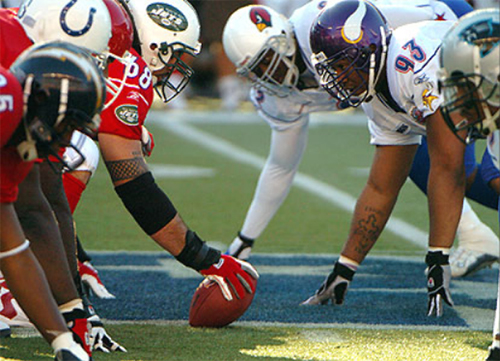
NFL in Talks With ESPN, In Bid to End Cable Battle


Seeking to end an embarrassing dispute that kept live pro football games out of many homes, the National Football League's NFL Network is in talks to form a partnership with Walt Disney Co.'s ESPN cable sports network, according to people familiar with the situation.

An agreement would represent a big shift in strategy for the NFL: abandoning its effort to force cable operators into carrying its own network and thus paying it lucrative monthly fees. It would also send a message to other professional sports, which have enjoyed rising television fees for years, that even the biggest and most powerful league in the U.S. cannot launch a new channel without the consent of giant cable operators such as Comcast Corp. and Time Warner Cable Inc.

For fans, a deal could close a bitter standoff between the league and four of the nation's largest cable operators that has left live games on Thursday and Saturday nights unavailable to many cable subscribers.

NFL executives including Steven Bornstein, chief executive of the NFL Network and previously chairman of ESPN and president of Disney's ABC unit, have been holding high-level discussions with Disney executives in recent months, according to several people familiar with the situation. Some team owners have been briefed on the discussions, and Disney CEO Robert Iger and NFL Commissioner Roger Goodell have been involved, these people said.

One scenario that has been discussed would involve combining the NFL Network with the ESPN Classic network, which has relatively low ratings but wider distribution. ESPN would broadcast eight more games per season on ESPN Classic, and then attempt to wring higher subscription fees than the 16 or 17 cents it currently receives for the channel, according to Derek Baine, a senior analyst for SNL Kagan.

Under such a scenario, ESPN and the NFL could form a joint venture and share revenue, or ESPN could take an equity stake in the channel.

To be sure, there is no guarantee the two sides will reach a deal. Talks have been under way for some time, and an agreement doesn't appear to be imminent, according to people familiar with the situation.

"We have a long-term and extensive relationship with the NFL and to that end we are always in discussion with them about mutual projects,'' said Mike Soltys, vice president of communications for ESPN.

Dennis Johnson, an NFL Network spokesman, said: "We are in talks with ESPN and our other broadcast partners all the time about a wide range of issues."

The NFL ran up against the cable operators in early 2006, when the league decided to withhold eight games from its lucrative TV licensing packages to put on its own channel. In effect, the NFL was giving up the hundreds of millions of dollars it would have received had it licensed rights to those games to a sports network. Instead, it put those games on its own channel, hoping to create a valuable cable asset with no middleman. But the NFL may have misplayed its hand in demanding about 70 cents per subscriber, which cable operators argued was high for a channel with so few games per season. Cable operators balked, and football fans didn't protest as much as the league thought they might.

Time Warner Cable, the country's second-largest cable operator, has refused to carry the NFL Network on the league's terms. Comcast, the country's largest cable operator, pulled the NFL Network from millions of homes after a bruising, bitter battle over the rights to the eight games, for which it had offered over $400 million.

The NFL Network's major distribution is on satellite service DirecTV and smaller providers. It is available in approximately 40.3 million homes, according to Nielsen Media Research, roughly one-third of all households with TV. It averaged 196,000 viewers during prime-time in 2007, according to Nielsen. ESPN Classic is in 62.7 million homes, according to Nielsen.

For football fans who don't already receive the NFL Network, a partnership would likely bring those eight games into their living rooms for the first time. But if ESPN gets a price increase, it could also boost cable fees across the board.

A combination would give an edge to ESPN over its broadcast competitors, and provide a boost in subscriber and advertising revenue for ESPN Classic, which averaged only 107,000 prime-time viewers in 2007, Nielsen says. It may also be a bitter pill for Mr. Bornstein, who at times had a strained relationship with Mr. Iger when he was at Disney, according to people familiar with the situation.

The writing may have been on the wall for the NFL network since late December. The network was scheduled to be the exclusive national broadcaster of one of the most highly anticipated events of the season: the game in which the New England Patriots defeated the New York Giants to become the NFL's first regular-season undefeated team since the 1972 Miami Dolphins. (The Giants later beat the Patriots in the Super Bowl.)

Politicians, including Sen. John Kerry (D., Mass.), urged the league to make the game more widely available -- and the NFL eventually capitulated, allowing both CBS and NBC to broadcast the game. The move undercut its negotiating position, by signaling that the league could be strong-armed into opening up a sufficiently important match-up to a wider audience.

By: Sam Schechner, Matthew Futterman, & Merissa Marr
Wall Street Journal; June 21, 2008

If you've been blacked out of can't view NFL games on your TV at home, why not go to an NFL game? Visit Online Tickets USA for the best NFL ticket deals!

Monday, June 23, 2008

Children's Product Industry Put in Regulatory Bind

Congress Battles Over Rules as States Boost Safety Efforts

The $33 billion-plus U.S. children's product industry faces increasing state efforts to regulate its products while Congress wrangles over federal rules that won't be in place in time for this year's holiday shopping season.

That could fuel consumer worries about another slew of safety recalls and leave many makers of children's products uncertain about how to comply with a proliferation of state standards and a federal framework that still is uncertain.

Mattel Inc., which had to recall millions of toys last year because of problems that included potentially deadly high-power magnets, said it supports tougher federal standards that give the industry clear and uniform rules.

"Some states have passed extremely restrictive laws that, depending on how they are implemented, may make it impossible to sell many safe toys in these states," said Mattel spokeswoman Lisa Marie Bongiovanni, who said the company supports uniform national standards of regulation. "Fifty different state standards will create a confusing patchwork of regulations, limit certain toys sold in some states, drive up costs for consumers and will not substantively increase toy safety," she said.

Toy manufacturers must comply with a 1970s-era law limiting lead to 600 parts per million for paint used on houses or toys. The push to tighten those standards follows recalls last year of 25 million toys and millions more children's products such as pajamas, jewelry and furniture. Many of those recalls were for lead.

In an overhaul that is the most sweeping in a generation, manufacturers in the U.S. toy and children's product market would have to ratchet lead down not only in paint but also in most components -- possibly even parts not accessible unless the item is taken apart. Complying with lead content limits of 100 parts per million will prove far easier for large manufacturers and retailers than for small outfits that make up the bulk of certain segments, such as jewelry.

Mattel, Hasbro Inc., Wal-Mart Stores Inc. and Target Corp. have more resources and heft to prepare for anticipated changes and have done so already in the U.S. and the more tightly regulated European market.

Wal-Mart has instructed suppliers they will have to meet new lead and chemicals safety standards by the fall that are more stringent than current government regulations. Target has said it is banning phthalates, a plastics additive linked to developmental problems in children, from its store-branded products by year end. Target also is lowering allowable lead limits in children's products and jewelry, ahead of federal action.

Hasbro Chairman Al Verrecchia said the company already ensures that accessible parts in its toys contain no more than 100 parts of lead per million, a level the federal legislation doesn't envision for at least three years.

The problem for consumers is that children's products for the holidays already are starting to ship from China and elsewhere to the U.S. because the manufacturing cycle is nine to 18 months from design to retailer. Manufacturers already are designing 2009's toys without clear federal guidelines.

Congress repeatedly has delayed release of a final version of the safety standards, which are part of a broader overhaul of the Consumer Product Safety Commission, the nation's chief product-safety regulator.

The bill was expected to come to a vote next week but now could be delayed further, because of arguments among House and Senate negotiators over whether the new federal standards could pre-empt state regulations.

After delays in Congress and continued weak federal oversight, 16 states have devised laws that are in some cases stricter than what Congress envisions. A proposal in Washington state would curb allowable levels of lead in toys and other products to at most 90 parts per million compared with the 100 parts per million proposed by the House and Senate bills. Industry lobbyists said the competing rules will confuse consumers, make compliance difficult and encourage multiple actions against businesses.

The engineering division of car-seat maker Sunshine Kids Inc. already conducts 50 sometimes-overlapping tests to comply with competing state and federal standards, adding as much as 30% to the cost of a child seat, the company said. Sunshine Kids's chief engineer said it could take nine months to check a seat's 150 separate parts for lead content, to comply with coming state and federal laws.

Archie McPhee, a quirky toy shop that is a landmark in Seattle, has said it will close if Washington state enacts a law setting the toughest lead standards in the nation and restricting the use of several other chemicals. The standards, slated to take effect in mid-2009, would be far tougher than the federal proposal, which may or may not ignore plastics additives such as phthalates, which would be banned in Washington and California.

The largest retailers still aren't immune. In April, the Consumer Product Safety Commission, in cooperation with Wal-Mart, issued a recall notice of 12,000 Chinese-made "Hip Charm" key chains distributed by the retailer because of charms that can contain high levels of lead, the agency said. That recall followed an alert from the Illinois attorney general, the agency said.

Smaller retailers are anticipating some challenges. Sharon DiMinico, president of Learning Express, a specialty toy retailer and franchiser, said she expects there could be some delays getting certain products from vendors that might have slowed production because of uncertainty about changing regulations.

The CPSC has suffered for three decades from slashes in budget and staffing initiated during the antiregulatory fervor of the Reagan era. The agency of about 400 acknowledges its struggle to police more than 15,000 products in a global marketplace where 80% of toys sold in the U.S. come from China.

Aside from resolving differences on pre-emption, the House and Senate negotiators also have had to resolve divisions on other measures in the bills, including disagreement on whether a final bill would cover products for children of up to age 7 or as old as age 12. The bills also differ on how soon the lead standards should take effect or whether other chemicals should be included.

Manufacturers are fighting a measure in both bills that would post consumer reports of product-safety problems online, saying the database could provide a forum for baseless claims by competitors.

The Bush administration has said it is committed to continuing a strong product-safety system. The administration said the House bill "takes positive steps" to further protect Americans, and the White House supports "many of the measures" in the Senate bill, but it expressed some concerns with others.

By: Melanies Trottman & Elizabeth Williamson
Wall Street Journal; June 18, 2008

Thursday, June 19, 2008

Stop That Thief!

Losses From Theft and Fraud Can Sink a Small Business; Technology Offers Welcome Relief.

For small businesses, preventing theft and fraud by employees can be an uphill struggle.

Unlike their big counterparts, small companies usually can't afford a large security staff or big-ticket monitoring technology to keep an eye on things. And they often don't generate enough sales volume to make up for the losses from pilfering.

Now a new generation of security technology aims to give small businesses an inexpensive defense against unscrupulous employees. Some of these systems let business owners who are on the road check their security cameras over the Internet and get email alerts if something unusual happens, such as employees closing up shop early.

Restaurants, meanwhile, can use table-side credit-card readers to prevent cashiers from stealing customers' card numbers or inflating the tips written on bills. And grocery stores can use a combination of security cameras and software to automatically spot cashiers who try to slip free products to their friends and family.

These new products are arriving as stores face mounting losses from theft. According to the latest National Retail Security Survey, losses from "shrinkage" -- which includes theft, fraud and error -- reached a new high of about $40.5 billion in 2006. About half of that -- $19 billion -- came from employee theft. Shoplifting, in contrast, accounted for about a third. (The study, conducted by the University of Florida and the National Retail Federation, was funded in part by grants from makers of security systems.)

Here's a look at some of the most innovative new security systems out there.

WATCHING FROM AFAR

For a small-business owner worried about employee theft, leaving the shop in someone else's hands can be nerve-wracking. Now a host of security providers let bosses check in on things from the road.

For instance, Alarm.com Inc., of McLean, Va., sells a system that allows owners to travel to a Web portal and get remote feeds from security cameras, change entry codes and trigger sensors that monitor systems such as lighting and climate control. If a problem arises with those systems -- such as a power outage -- you can get an alert via a text message or email.

Recently, Kevin Donahue, owner of a Planet Beach Franchising Corp. location in McLean, was in Amsterdam on business when he received a text message from Alarm.com: The spa's alarm system had been armed at 3 p.m., before the usual closing time. He checked the security cameras online and saw the facility was dark.

So he called his manager and got the explanation: The spa had closed early because of a snowstorm..

"The greatest thing is that it gives me the ability to travel and do the things that I do," says the 34-year-old Mr. Donahue, who's also a full-time salesperson for a tech company and often travels outside the country on sales trips. "It gives me the ability to manage my staff remotely. I can call and say, 'What's going on?' "

Mr. Donahue bought the system for under $100 and pays a monthly fee of $39. Alarm.com says the base price for the system is usually $500, with a monthly fee of $29 to $50, although those numbers can vary by reseller and area, as well as the features customers choose.

SAFEGUARDING CARDS

Another new technology helps small businesses -- particularly restaurants -- protect against "skimming." In this scam, cashiers steal customers' credit-card information for use in identity theft.

About 70% of credit-card-fraud cases involve skimming, according to Trustwave Holdings Inc., a data-security and compliance-management company based in Chicago. In many cases, business owners are ultimately held responsible for their cashiers' crimes -- costing them money and damaging their reputation.

For some businesses, the solution is to let customers become their own cashiers. At Southeast Grille House in Brewster, N.Y., servers bring a wireless gadget called On the Spot to their customers' tables. Patrons can swipe their credit cards on the device -- which is about the size of a brick -- punch in the tip amount and print out a receipt to sign, all from their seat.

Since the customer enters all the information, cashiers can't inflate the tip -- and the receipts don't contain much personal data that could be stolen and used for identity theft.

The device, from VeriFone Holdings Inc. of San Jose, Calif., runs about $1,000. Southeast Grille House owner Domenic Chiera says it was worth the investment. "It's fast, and the receipt has little information, so no names or numbers," says the 57-year-old restaurateur. "I like the system. It works well for us."

CHECKING OUT FRAUD

At grocery stores, thieving employees are almost as much of a problem as shoplifters. About 40% of grocery-store thefts were attributed to employees in 2006, according to the Food Marketing Institute's Supermarket Security and Loss Prevention 2007 report. One of the biggest problems is "sweethearting," in which cashiers give friends and family freebies by pretending to scan items at the register.

Many stores use closed-circuit television to watch checkout lines. But the stores often don't have the time or manpower to review the tapes, so the cameras aren't a strong deterrent. StopLift Inc. of Bedford, Mass., has devised a system that combines cameras with advanced software to spot sweethearting automatically. The technology can recognize when cashiers make unusual movements when handling items -- such as placing a hand over a bar code -- and determine whether the items were properly scanned.

When the system identifies sweethearting, it places blinking squares over the video to show exactly where the theft occurred. Then it gathers the incriminating clips together for owners to review.

Stores "have the cameras but they don't have the manpower to watch it," says Malay Kundu, chief executive of StopLift. "What we've done is sort of automate that."

Three Big Y Foods Inc. stores in Massachusetts and Connecticut have been testing StopLift's Checkout Vision Systems for the past five weeks. Mark Gaudette, director of loss prevention at the Springfield, Mass., grocery-store chain, suspects that employee theft accounts for about 38% to 40% of its total losses.

"We've got pretty much a zero-tolerance policy for any folks that steal," Mr. Gaudette says. "What we're hoping is that all these technologies will help us in loss prevention and educate all of our staff."

The stores had already been using closed-circuit television and software that scrutinizes sales data for abnormal behavior or inconsistencies at the cash register, such as excessive voids or refunds. But those measures weren't enough to stem the losses.

StopLift's system works with those tools to ferret out sweethearting. For instance, if the sales-data software shows that somebody rang up too many coupons on one order, the StopLift system can analyze video from the exact moment this happened.

Big Y is still analyzing the results. So far, Mr. Gaudette says, he has spotted some sweethearting incidents, but he has seen far more cashier errors, such as giving up on hard-to-scan items instead of calling the manager for help.

Pricing for the technology is done on a case-by-case basis, says StopLift's Mr. Kundu. He says that for a typical medium-volume store, monthly subscriptions currently run about $2,000.

Of course, buying these systems isn't the only option available for small stores. Experts suggest that stores could hire fewer part-timers -- who have less attachment to the business and are more inclined to steal -- and conduct more-rigorous pre-employment screenings to weed out potential thieves.

Employers must also hammer home a code of conduct, experts advise. For instance, give new hires talks on integrity and loss prevention and offer anonymous hotlines where employees can notify managers about fellow workers who may be stealing.

The bottom line is that employees must recognize they have a part to play in stopping theft, says Joseph LaRocca, vice president of loss prevention for the National Retail Federation. "Loss prevention is really everybody's responsibility," he says.

By: Raymund Flandez
Wall Street Journal; June 16, 2008

The Inside Scoop

Cold Stone Creamery attracted a lot of franchisees thinking it was a sure thing. It wasn't.

Earlier in this decade, Cold Stone Creamery was one of the hottest franchises around. The super-premium ice-cream stores attracted scores of franchisees hungry for a piece of the "Ultimate Ice Cream Experience."

Now many franchisees are selling their stores, overwhelmed by soaring bills and shrinking profits. Some have lost their homes, broken their retirement nest eggs or filed for bankruptcy.

Even as they rave about the quality of the ice cream, numerous franchisees say the numbers in Cold Stone's business model didn't add up. The cost of running one of the shops was so steep that making a profit was daunting, especially in an economy where a $4 scoop was a pricey indulgence, they argue. They also contend the company cut their margins even further by offering two-for-one coupons and making them buy costly ingredients from a single supplier. Some argue that the company's rapid expansion crowded stores too close together -- and brought in too many inexperienced franchisees.

A number of franchisees also contend the company misled them, giving them promises of profit potential that proved unrealistic or inaccurate revenue numbers from existing stores. And some say that they got little help from the company as their stores went under.

"They have a defective business model, there's no question about it," says Ken Gornall, a former franchisee who closed his Glendale, Ariz., store last October. He adds that the average revenue numbers he received before signing up "were quite misleading," exaggerating likely annual sales.

Cold Stone says more than 100 of its stores closed last year. That's up from 60 in 2006. One list on a Cold Stone Web site recently had 303 stores for sale -- more than 20% of the company's 1,384 as of last December.

This "combination of numbers is very, very high," says franchise attorney Eric Karp of Boston law firm Witmer, Karp, Warner & Ryan LLP. "I think it's a symptom of bad news and not good news." (Mr. Karp, who specializes in representing franchisee associations and individual franchisees, hasn't represented Cold Stone store owners.)

Cold Stone has been franchising only since 1995, and Mr. Karp concludes that 12 years or so would be an unusually short time for first-generation franchisees to be cashing out and retiring.

Chris Prasifka, Cold Stone's president, acknowledges that the "inventory of stores for sale now is higher than it has been." But a company spokeswoman terms the for-sale number "at par with industry expectations," given "the economically challenging times." She adds that about 230 of those listed for sale are stores in operation; the rest are "awards" to develop future stores.

The company also contests the franchisees' charges. Cold Stone insists it doesn't provide profit potential to prospective franchisees. It also says the revenue figures it gave for existing stores were based on franchisee reports.

Costs, meanwhile, "will depend on how well a store is operated," Mr. Prasifka says. Cold Stone says it uses a one-stop distributor to ensure efficiency, quality and economies of scale. It adds that franchisees can buy ingredients elsewhere at lower prices if the product is identical. Cold Stone says it won't distribute national two-for-one coupons this year, after franchisee complaints.

And the company says that it's selective about adding franchisees, typically approving about 2% of applicants. As for their chances of succeeding, Mr. Prasifka asserts that "it's no different from any other business. You've got to work it." He adds, "It does take a year or two to understand the business."

Overall, Mr. Prasifka says, "We want all franchisees to succeed. However, minimal restaurant experience, a lack of desire to do local-store marketing or the inability to be operationally excellent can all contribute to a franchisee's inability to succeed."

Cold Stone was a stand-alone brand for 19 years before being acquired by fast-food franchiser Kahala Corp. last year. Other Kahala brands include Blimpie sandwiches and TacoTime Mexican food. Kahala's plans call for slowing Cold Stone's expansion, reducing new-store construction costs and finding ways to grow average annual store sales to about $500,000 from about $360,000 now.

For many franchisees, the new ownership comes too late. Formerly an independent real-estate agent, Mr. Gornall signed up for a Cold Stone franchise in June 2004. "The stores seemed busy all the time. You assume that 'busy' equates to profitability," he says.

Before buying, Mr. Gornall called half a dozen franchisees. "No one said, 'This is a bad deal,' " he remembers. But it soon became clear that something was amiss. Mr. Gornall already faced high overhead such as a $3,700-a-month lease, he says. Then, he says, the company squeezed his margins further by mandating that he buy what he considered expensive ingredients, in larger quantities than he needed. Mr. Gornall adds that the company's promotional couponing shrank his profits.

Along the way, he says, he didn't get much help, either from Cold Stone or the area developer -- a company representative assigned to sell franchises in the area and monitor the franchisees. The area developer, Sean Brown, visited his store only once, Mr. Gornall recalls, and didn't have any good ideas for boosting sales.

Mr. Gornall and his wife borrowed on their personal credit cards to pay the store's bills. But after their losses exceeded $100,000 last fall, they gave up and closed their store. They lost their house and are filing for bankruptcy. "It's been pretty devastating," he says.

Still, "I share some responsibilities" for failing, Mr. Gornall adds. "Maybe I should have closed sooner, but I kept on thinking things would be better."

The company wouldn't comment directly on the Gornalls' case. But Mr. Prasifka says, "When a franchisee asks for support, we make it a priority to get someone from our team to visit them, discuss their situation and get to the root cause."

He says if franchisees aren't satisfied with the support they receive from their area developer, there are "multiple resources," including an ombudsman, available. But he acknowledges that "during tough times, we will have some franchisees who will struggle."

The company didn't comment on Mr. Gornall's complaints about Mr. Brown, which were echoed by several other ex-franchisees. Cold Stone terminated Mr. Brown in January 2007 after he "habitually failed to pay royalties, rent, advertising and other amounts" on Cold Stone stores he owned, according to a company document in a tax-levy dispute with the government in U.S. District Court in Houston. The dispute arose over who should pay income and employment taxes owed on Mr. Brown's stores. The government looked to Cold Stone, but the company argued that Cold Stone didn't have an interest in Mr. Brown's properties at the time the lien arose. Mr. Brown declined to comment.

Citing surveys of franchisees, Mr. Prasifka says that overall "they're very satisfied with their area developers," whom he calls "world class." He says three of the two dozen or so have left the system in the past two years.

Some franchisees argue that the chain expanded too rapidly in its early years. "They did overbuild across the country, no question about it," says Michael Goldman, a Northern California franchisee with seven stores and a seat on Cold Stone's National Advisory Board, a group of franchisees who meet to discuss the business and give franchisee feedback to management.

The rapid growth meant new stores were frequently close to old ones, cannibalizing sales, Mr. Goldman argues. "I'm sure there are sites that should never have been picked and franchisees that should never have been picked" because of their lack of experience, he says.

But while many failed Cold Stone franchisees were new to franchising, experienced franchisees also have lost money. "This was not our first rodeo," says Deborah Lickteig, whose family had operated KFC chicken outlets in Arizona and New Mexico.

"We worked it real hard for a year," she says. But she and her husband sold their store in June 2006 after weekly sales at the San Antonio outlet fell several thousand dollars short of what she calls "skewed" pro-forma figures from the company. A glut of Cold Stone stores in the area, high food costs and the buy-one, get-one-free coupons made things worse, she says. Cold Stone wouldn't comment directly on the Lickteigs.

Former Florida franchisee Cecil Rolle has become more nettlesome to Cold Stone than most. After the company terminated him last year, it alleged in a Florida circuit court action that he had been caught removing equipment from one of his three Florida stores in the middle of the night. The company also filed suit in federal district court in Tallahassee to recover what it said are substantial sums he owes.

Mr. Rolle acknowledges seeking to remove equipment and withholding payments. But he and his wife have countersued, contending among other things that they were misled when told they would make "right around a 20% profit" on a mall store they bought. Cold Stone wouldn't comment on Mr. Rolle's allegations, but in a recent email to franchisees, a Cold Stone attorney sought to counter what he termed "Mr. Rolle's inaccurate and misleading attacks against us."

Mr. Rolle is trying to organize other franchisees for a possible class-action suit seeking some remedy from Cold Stone and Kahala. He spends much of his days at his Gainesville, Fla., home emailing with disillusioned former and current franchisees. "I feel like I'm doing something good," he says. And last month, Mr. Rolle opened an ice-cream shop in Tallahassee -- on the site of a former Cold Stone store.

By: Richard Gibson
Wall Street Journal; June 16, 2008

Friday, June 13, 2008

Decision Time for Lehman


Balance-Sheet Woes Most Likely to Force Big Strategic Shift

It is time to sort out the Lehman problem.

With its stock falling two days in a row, investors see Lehman Brothers Holdings Inc. as the latest firm weighing on financial stocks.

The problems in Lehman's balance sheet could force the firm to issue a large amount of equity or to sell part, or all, of itself to a larger financial firm.

While such options would be excruciating for the company's management and existing shareholders, that may be what it takes to bolster confidence in the investment bank and to stop concerns about the firm affecting the wider financial system.

Following an 8.1 percent drop Monday, Lehman shares slid 9.5 percent Tuesday. The latest decline came even though Lehman was buying back large amounts of its own shares. Tuesday in New York Stock Exchange trading, Lehman shares were down $3.22 at $30.61, 22 percent below their book value the measure of a company's net worth based on assets minus liabilities at the end of February.

The steep discount to book value apparently reflects investor discontent about the values Lehman has placed on its assets, many of which are backed by distressed real-estate loans. And the discount is also a sign that investors doubt management's ability to navigate this crunch.

Lehman is scheduled to report a loss for its fiscal second quarter, ended May 30, when it reports results the week of June 16.

Lehman's first option is to raise a large amount of capital. The Wall Street Journal reported Tuesday that Lehman was weighing whether to issue as much as $4 billion in new stock. But Tuesday's drop in Lehman's share price the stock was down about 15 percent at one point during the day makes it harder to sell new stock.

Selling at this level would be more expensive for the firm, especially if a buyer demanded a steep discount to the current depressed price. Lehman's market value has fallen to about $17 billion, so even a $4 billion capital raise is nearly equal to about 25 percent of the firm.

And investors may want to see Lehman raise even more than $4 billion to cover any future losses from marking down the value of its assets. Lehman is likely to report large losses on trades made to hedge assets in the second quarter. And critics argue that Lehman has lagged behind in marking down the value of assets backed with distressed residential and commercial mortgages.

There is another important reason why Lehman may need new capital: It likely needs extra cash to forestall another downgrade by ratings agencies.

Standard & Poor's Corp. Monday downgraded Lehman to single-A from single-A-plus, but kept the firm on negative watch. Lehman had indicated that such a downgrade could force it to post about $200 million in additional collateral to back derivatives trades.

Another downgrade could force the firm to post $5.4 billion in additional collateral, according to a note Tuesday from Brad Hintz, an analyst at Sanford C. Bernstein & Co. and a former Lehman chief financial officer.

Lehman's other option is to sell a stake to another firm or to sell out completely. The problem here is that the credit crisis has left few prospective buyers. So who might be left to step up?

At the right price, Lehman may make an attractive target for a private-equity firm or hedge-fund group that wants to add brokerage and investment-banking operations. Blackstone Group CEO Stephen Schwarzman is a Lehman alum who has long wanted to add more investment-banking businesses to his firm.

Citadel Group, a money manager with some sales and trading operations, may want to do the same. J.C. Flowers proposed buying Bear Stearns before its collapse, so interest from that buyout group wouldn't be a surprise.

A large commercial bank may also be drawn to Lehman at a discount to book value, especially if it gets time to go over the investment bank's assets to assess their value.

It is possible that Lehman, which survived the 1998 market meltdown and the credit crisis in March, can weather the latest storm. Lehman does have some time to work out if it wants to do something drastic, like sell out. Lehman can avoid a short-term funding squeeze since it can borrow directly from the Federal Reserve, but the Fed could get impatient if Lehman doesn't do something soon.

So, it can't put off the tough choices for much longer.

By: Peter Eavis & David Reilly
Wall Street Journal

Time Warner, Comcast to Test Web-Usage Plans

Time Warner & Comcast Need to Rethink Network As Internet Traffic Increases And Slows Things Down

Comcast Corp. and Time Warner Cable Inc. will Thursday each begin tests of ways to manage Web traffic on their Internet networks, a contentious issue that has drawn scrutiny from regulators and consumer groups.

Comcast said it will test limiting bandwidth available to heavy Internet users at times of network congestion. The cable operator will test the approach in the Chambersburg, Pa., and Warrenton, Va., markets Thursday. Tests will also soon be under way in Colorado Springs, Co.

Time Warner Cable will try a different approach. The cable operator said it plans to start metering new subscribers -- charging them $1 a gigabyte for Internet usage above a monthly allowance -- beginning Thursday in Beaumont, Texas.

"We realize this will require a cultural shift away from the all-you-can-eat model consumers have grown used to and we want to see what our customers' response will be," said Time Warner Cable spokesman Alex Dudley.

The growth of video and music file sharing has created problems for Internet service providers but particularly cable companies, whose Internet networks are shared among users at the neighborhood level. That means users consuming lots of bandwidth can slow the network performance for those living nearby.

Comcast had said it would experiment with ways to cope with surging Internet traffic on its network. The company had admitted to slowing certain types of bandwidth-heavy applications such as peer to peer file sharing technologies. But advocates of so called net neutrality, who say service providers should not prioritize one type of Internet traffic over another, argue Comcast's approach unfairly targets certain applications and will ultimately hinder consumer choice. By curbing the amount of bandwidth available to heavy users rather than throttling particular applications, the company may deflect some criticism.

Congress is considering legislation that would rein in a carrier's ability to throttle traffic on its network, and the Federal Communications Commission is also investigating the issue.

Time Warner says about 5% of the company's subscribers account for half of local bandwidth use. Mr. Dudley said metered billing is an attempt to deal fairly with the explosive growth of Internet traffic, and the huge amounts of bandwidth consumed by a minority of customers. "We want to find the most equitable way to deal with this issue," said Mr. Dudley.

By: Vishesh Kumar
The Wall Street Journal; June 04, 2008

Viacom Sees Slowdown in Rate of Ad Growth

Viacom Inc. is seeing a slowing rate of growth in advertising in the second quarter, the company's chief executive said Wednesday, in one of the first admissions by a big media company that the economy is beginning to hurt the national ad market. Viacom expects to see domestic ad-sales growth of 3% to 4% in the quarter ending next month, well below the 7% growth the company reported in the first quarter, Philippe Dauman said at the Sanford Bernstein & Co. Strategic Decisions Conference in New York.

ComScore Buys M:Metric Inc.

ComScore Inc. said it acquired M:Metric Inc., which, through surveys and on-device meters, offers services to measure mobile-phone use, mobile Internet behavior and tracking services for mobile advertising. ComScore, a Reston, Va., Internet-use tracking company, will pay $44.3 million for M:Metrics, and the deal also involves the issuance of about 50,000 options to buy comScore common shares to certain M:Metrics unvested option holders. M:Metrics expects revenue in 2008 to be about $11 million to $12 million.

Cable & Wireless Talks to Rival Thus

Cable & Wireless PLC, the united Kingdom telecommunications company, said it had approached smaller rival Thus Group PLC about a possible bid, which, according to one London-based analyst, would likely be in the range of £270 million to £280 million ($534 million to $554 million). Thus, which is unprofitable, mainly provides fixed-line and wireless telecom services to businesses and the public sector. Its Internet provider, Demon, largely serves small businesses. Cable & Wireless said the approach wasn't a firm intention to make an offer.

Thursday, June 12, 2008

Dell Still in Need of Cost Control


It has been more than a year since Michael Dell returned to Dell, Inc., but the company doesn't seem to be rebooting very quickly.

Mr. Dell, founder of the computer-making giant, has been overseeing a restructuring since he returned as CEO in January 2007 after a three-year hiatus.

Mr. Dell has replaced executives, pursued new product lines and cut more than 5,300 employees, with at least 3,500 more to go.

Yet as of the end of January, costs were still a problem. Dell's selling, general and administrative expenses were up 50% at the end of the last quarter compared with two years ago, while revenue was up less than 10% over that period. Some of this may be due to current economic conditions, in which many people have turned to buying discount laptops from a variety of online sellers.

Analysts don't expect much better in the current quarter, which Dell will announce after Thursday's close of trading. They forecast net income of 32 cents a share, off about 6% from last year, due to stubbornly high costs, competitive pricing and weaker U.S. business and consumer spending.

“Dell is a show-me story,” says Toni Sacconaghi Jr., a Sanford Bernstein analyst. While he likes it in the long run, it hasn't shown yet.

By: Karen Richardson
Wall Street Journal

WiMAX Patent Pool Is Planned

Firms Aim to Spur Use by Limiting Royalty Payments

Six big technology companies are spearheading a plan to jointly license patents that cover the wireless technology called WiMAX hoping to limit royalty rates that could deter customers from using it.

The participants are Cisco Systems Inc., Intel Corp., Samsung Electronics Co., Sprint Nextel Corp., Alcatel-Lucentand Clearwire Corp., according to people familiar with the situation and a document outlining the group's plans.

They have scheduled a conference call Monday to announce an organization, the Open Patent Alliance, to gather rights to WiMAX-related patents and license them to makers of computers, networking devices and other products, these people said.

WiMAX is a long-range cousin of a wireless technology called Wi-Fi that comes with many laptop computers. Intel, which heavily promoted Wi-Fi, has been pushing to make WiMAX another built-in feature of portable PCs. Sprint and Clearwire plan to build a nationwide WiMAX - network, while Samsung, Cisco and Alcatel-Lucent are expected to make WiMAX equipment.

But hardware makers could be spooked if patent royalties are too high or the potential costs are uncertain. WiMAX backers cite the case ofthird-generation cellular networks; companies such as Qualcomm Inc., Nokia Corp. and Telefon AB L.M. Ericsson separately charge patent royalties for 3G products.

Some industry analysts say cellphone makers face cumulative royalties of more than 25% of the price of handsets, unless they have their own patents to help in negotiating lower rates. One person familiar with the thinking of the WiMAX alliance said it hopes to license WiMAX patents at "much lower" rates than those in the cellular industry.

Such patent pools aren't a new idea. A group called MPEG LA, for example, offers standard royalty rates for licensing patents associated with video compression. Patent pools are "tremendously important," said David Balto, a Washington, D.C., lawyer who handles patent and antitrust issues.

But the WiMAX alliance, which was reported by Computerworld Friday, faces several challenges. One is a competing standard-knpwn as LTE, for long-range evolution-that shares a common technical foundation with WiMAX and is expected to be preferred by many cellular carriers.

And some prominent holders of patents related to WiMAX and LTE-including Motorola Inc. and Qualcomm-haven't joined the patent pool and could continue to make their own claims for royalty payments.

Until they explain their licensing plans, some uncertainty for equipment makers will remain despite the existence of the new patent pool, said Mike Thelander, an analyst with Signal Research Group, in an email.

A Qualcomm spokeswoman said the company wouldn't join the WiMAX alliance. Though patent pools are a valid approach, "Qualcomm has consistently preferred to negotiate license agreements bilaterally," she wrote in an email. Qualcomm has already licensed patents covering technologies used in WiMAX to nine companies, she added.

A Motorola spokeswoman said, "We continue to evaluate the merits and risks associated with every proposal that we hear about, and we continue to make our own suggestions for improvements."

While some LTE backers are also pushing for a patent pool, Mr. Thelander predicted that WiMax and LTE royalties ultimately may be quite similar. But Larry Goldstein, a patent lawyer who wrote a book on patent pools, said the WiMax group could reduce the number of licensing deals to be negotiated even if some patent holders don't join. "It can cut down on the onerous negotiations and cut down on the overall royalty rate," he said.

By: Don Clark
Wall Street Journal; June 9, 2008

Wednesday, June 11, 2008

CBS to Lay Bare Its Plans

Web-Video 'Skins' To Be Main Ad Tool In a 'Burly' Venture

CBS is about to start showing some skin.

About a year after they were introduced, a handful of video-ad formats -- called bugs, tickers and skin -- are jockeying to become the favorites among marketers.

CBS plans to carry "The Burly Sports Show" on its Web site and will use a format known as a skin to sell ads next to the show.

The skin format, in which the ad appears in a graphic surrounding the window where the video plays, has been slower to gain momentum because it isn't widely available on top video sites. But it is about to get a lift.

On Wednesday, CBS will announce that it has reached a deal to carry an irreverent show called "The Burly Sports Show" on CBSSports.com. The show, which draws two million visitors each month, covers wacky events such as a failed marriage proposal during halftime of a Houston Rockets basketball game and a baseball mascot's fall during a running race. A part of the distribution deal is CBS's plan to use the skin format as the primary tool to sell ads next to the show.

For all the hoopla over online video, the video-ad business still is finding its feet. Just last month, the Interactive Advertising Bureau, a trade group that represents more than 375 publishers, released standards for various types of online-video ads. The new formats, which deal with the technical specifications of the commercials, cover preroll, midroll and postroll ads (ads that appear before, during and after a video), and the formats for skin, bugs and tickers. (Bugs are logos that appear in text or graphics on or next to the video, while tickers are horizontal bars that usually run on the bottom of the video.)

But the formats are just the beginning of trying to build a foundation for these emerging types of video ads. Ad executives still are trying to figure how much to pay for an ad bug or an ad skin -- different publishers use different formulas to come up with their ad rates -- and how to gauge their effectiveness.

"How do you really measure how successful it is? That's the gap that has to be closed with video," said Sean Muzzy, senior partner and media director at Neo@Ogilvy, a digital-ad agency owned by WPP Group's Ogilvy and Mather.

When it all shakes out, it is unlikely a single video-ad format will be the winner. Rather, several are likely to predominate. In addition to trying to see how the formats stack up against each other, marketers also are experimenting with using formats in conjunction with each other. Advertisers are expected to spend $989 million on online-video advertising this year, more than double the $471 million in 2007, according to Forrester Research, of Cambridge, Mass. But that growth is off a small base.

"The Burly Sports Show" is produced by a company called Heavy, which is one of the major companies in the skin-ad business. Heavy, which is trying to strike agreements with other online publishers, said skins are one of the most-effective forms of online-video ads. It claims that click-through rates on the ads displayed in the video skin average 1.68%, compared with the fraction of a percentage point marketers see on most banner ads.

The technology also can include a video-search function, which could carry videos from multiple publishers, and a section to display related videos. Heavy said these features encourage viewers to watch more videos, which would mean a bigger audience a publisher can sell to advertisers.

But marketers said each format has its pros and cons. Marketers like skin ads because they can easily swap out ads to target certain groups of consumers; the skin ad appears behind the video and isn't related to what goes on inside the video. But advertisers also said that because the skin ad appears in the background of a video, viewers can easily ignore them.

Marketers also like preroll, midroll and postroll ads because they can take the TV ads they already have created and chop them up to fit the Web. But marketers said these ads often aren't appropriate for short videos, noting users become annoyed when there is a 30-second ad for a minute-long content clip.

Heavy isn't the only company in the skin-ad game -- InSkin Media, among others, also is courting publishers. And Heavy faces other potential challenges. Founded in 1999 as a producer of online shows aimed at 18- to 34-year-old men, Heavy plans to announce Wednesday that it is splitting off out its video ad-technology business into a company called Husky Media.

It will soon find out whether there is a robust enough market for its skin-ad technology to support a stand-alone company. CBS, for one, said it didn't decide to work with Heavy because of the skin ads; instead, it was attracted to the sports show. CBS said the deal is a way to boost the entertainment on its site.

"[Heavy's video-ad tool] didn't drive why we did the deal. We did the deal for the content," said Jason Kint, senior vice president and general manager of CBSSports.com and CBSNews.com.

By: Emily Steel
Wall Street Journal; June 4, 2008