
Original Story: Forbes.com
Handyman haven Home Depot HD announced Thursday that longtime CEO Frank Blake will step down on November 1. He will be replaced by Craig Menear, the company’s current U.S. retail president.
In his current role Menear oversees the company’s supply chain network, global sourcing and vendor management, as well as its marketing and digital business. Since joining Home Depot in 1997 Menear has served in various high level merchandising roles including, most recently, executive vice president of merchandising.
In a statement announcing the transition Blake noted, “Craig has taken on increasing leadership responsibility over the last several years and has excelled in all his role. As a long-time Home Depot veteran, Craig lives our values and embodies our culture. He’ll do an outstanding job leading our company in the years ahead.”
Blake, who has been chairman and CEO since 2007, will stay on as chairman of the board. Menear will immediately join the board of directors.
Shares of Home Depot ticked down slightly in after hours trading following the news, yet the small downward momentum comes after a trading day where the the stock came within a penny of its $91.81 52-week high. The transition also does not come as a big surprise to those who watch Home Depot closely. Blake, 65, was expected to retire soon and Menear led much of the company’s most recent earnings call, which took place just two days ago.
Blake is going out on a high note. In the second quarter Home Depot handily beat Wall Street expectations and even raised its full-year earnings guidance. FORBES’ Maggie McGrath wrote Tuesday,
Home Depot reported $23.8 billion in second quarter revenue, a 5.7% increase over the year-ago quarter and a figure that cleared the $23.5 billion Wall Street consensus. Comparable store sales for the quarter increased 5.8% worldwide, and within the U.S. same store sales grew 6.4%. Customer transactions increased 4.2%, while average ticket size grew 1.8% to $58.43.
The company’s net income came in at $2.1 billion, or $1.52 in earnings per share, a figure that beats the analyst consensus by 8 cents per share and marks a 22.6% improvement over the earnings per share reported this time last year.”
This also turned out to be a favorable comparison to rival Lowe’s, which reported its second quarter earnings Wednesday, a fact that must be sweet for Blake.
Under Blake’s predecessor, Robert Nardelli, Lowe’s share price lapped Home Depot’s. At this time last year Paula Rosenblum, a FORBES contributor, wrote of Home Depot under Nardelli, “A lot of opportunity was missed. Earnings were adequate, but they were riding on the back of cost-cutting, not sales improvements.” Rosenblum continued,
Today that’s certainly not the case. In fact, at least one analyst at the Smead Value Fund gave Home Depot a slightly stronger buy rating than its rival, although both stocks are expected to perform well as the housing market continues to improve.
This begs the question: What has changed under the leadership of Frank Blake? What is Home Depot doing right? The answers can be found not today, but in the doldrums of the Great Recession, which Mr. Blake’s team took as an opportunity to right a very shaky ship. Changes were steady, yet sweeping, and included marketing, technologies, stores, and human resource allocation.”
Currently, Home Depot shares are up 127% since the start of 2007, the year Blake took the reigns. Shares of Lowe’s are up just 69% over the same period.
Showing posts with label CEOs. Show all posts
Showing posts with label CEOs. Show all posts
Friday, September 5, 2014
Wednesday, January 11, 2012
CEOs Making Money
First appeared on CNN Money
If you could bluff your way into an S&P 500 CEO job, how many days would you have to rough it to earn your current annual pay?
You'd rack up $24,473 per day 365 days a year if you were just middle of the pack, according to a recent GMI study of S&P 500 CEO pay in 2010. Your annual earnings on a weekly basis would be more than $171,000; for 60 days, that'd be a cool $1.5 million.
Of course, if you were a top negotiator, maybe you'd take home what McKesson (MCK) CEO John Hammergren did in 2010. His daily haul, based on his annual pay, was around $398,000, with a weekly total of $2.8 million and a 60-day payout of nearly $24 million.
Could you put up with the rigors given those rates?
Working the one job 24/7
Maybe you're concerned that if you took a job like that, it might engulf your life 24/7. There'd be no time for extracurricular activities.
Not to worry. You'd have the opportunity to work a part-time job too, earning some pocket change on the side. For example, take Hammergren, who took home the biggest bucks in 2010 ($145 million in total compensation), according to GMI. Beyond serving as CEO of McKesson, he has been a board member at HP (HPQ), which paid him around $387,000 last year. As a member of the board's compensation committee, Hammergren has been busy with CEO pay negotiations in recent years.
In 2010, when HP showed former CEO Mark Hurd the door following an investigation into his behavior, Hurd was given $12 million cash plus vesting of some stock. Based on Hammergren's own 2010 wages, $12 million would translate to just 30 days severance. Is that so unreasonable? Under the original agreement, Hurd was also entitled to stock valued $15 million or more. He gave that up, though, in the kerfuffle related to his decision to join Oracle (ORCL) as its co-president.
Hammergren also reportedly volunteered to be on the search committee that identified Hurd's successor, former HP CEO Leo Apotheker. With less than one year of service, Apotheker was ousted last year and walked away with around $25 million. Sound like a lot? That would only amount to slightly more than 60 days severance based on Hammergren's 2010 pay.
In any event, this one example should ease your mind somewhat. Being a CEO of a major S&P 500 firm does not mean you have to work the one job 24/7.
Cranky investors? Not quite.
What about investor expectations? With large CEO paydays, aren't investors bound to be snarky?
Maybe, but they don't really expect that much, when you consider what they're used to getting in the way of returns. The S&P 500 is down nearly 9% from where it was five years ago. Just working to move the dial a bit forward (rather than backward) will make you a hero. In Hammergren's case, McKesson stock has considerably outperformed the index.
The GMI study notes that some parts of McKesson's executive compensation practices raise eyebrows, like a half a billion dollars Hammergren would be owed if the company were acquired. Still, the board believes his pay is warranted given the company's strong returns, and investors approved his compensation plan last year.
Board oversight, in more ways than one
But what about other boards -- do you need to be concerned that bonus bonanzas could meet their demise, especially since the S&P 500 is now sitting at levels that had already been achieved in the 90s? Isn't pay for performance a major concern of boards today?
The issue is important to boards, according to a recent survey by the National Association of Corporate Directors and compensation firm Pearl Meyer and Partners. But there is no need for alarm. According to the survey, "More than 80% [of board members] …stated they are 'confident' or 'very confident' about how well their current [compensation] programs address the broader challenge of aligning CEO pay with performance."
Populist outrage: Long on anger, short on attention span
What about public outcry -- could that influence high pay? Again, prospective CEOs can put their fears to rest.
The U.S. retail investing public is generally indifferent and does not even monitor the pay votes of mutual fund managers, much less hold them accountable for those made on their behalf. And the Occupy movement (or a successor) would have to significantly expand its reach to truly take CEO pay practices to task.
There is some trouble brewing across the pond. UK Prime Minister David Cameron has called for a binding investor vote on pay (one that would require a response from a company) and some members of Parliament want board compensation committees to have employee representation. There's no immediate threat, though. It took eight years for the U.S. to adopt an advisory say on pay, following in the UK's footsteps.
All in all, it's a rosy picture. So what are you going to do? Any reason you wouldn't aspire to be an S&P 500 CEO?

Tuesday, September 27, 2011
Another New CEO for HP
Story first appeared in the Traverse City Record-Eagle
Hewlett-Packard Co.’s decision to fire CEO Leo Apotheker after just 11 months and replace him with former eBay chief Meg Whitman is another dizzying turn of the executive merry-go-round at a company whose leadership issues are tearing it apart.
Swapping Apotheker, who has now been ousted from two high-profile CEO jobs in two years, with Whitman, a billionaire who is best known for the decade she spent building eBay and her run for California governor, is a decision designed to stem investor fury over a series of questionable strategy moves.
Whitman’s star-power could be an asset for a company that struggled to gain credibility under Apotheker, who was previously little-known outside of the business software world. HP is no stranger to celebrity CEOs. But Carly Fiorina’s run as leading lady, from 1999 to 2005, ended in shambles.
Despite Whitman’s success at eBay, she is untested when it comes to running a sprawling company such as HP.
One professor commented that she build up a one-trick pony, an online auction site, and she oversaw the growth of the company, but the situation now is where someone needs to come in who has a technological background, and engineering and scientific background, and that that is way outside of her skill set. He added that the decision to change CEO’s so soon points to continued disarray on HP’s board, long a target of critics for the chaos it’s caused at one of Silicon Valley’s oldest and largest companies. Infighting and ego-driven drama has long plagued the board, from revelations in 2006 that HP had spied on directors and journalist to ferret out the source of leaks, to last eyar’s dismissal of CEO Mark Hurd in an ethics scandal.
The profession finished by saying that there’s no question the board is off the rails and that they need a smaller, tighter board that’s committed to the idea of what the company does.
Hewlett-Packard Co.’s decision to fire CEO Leo Apotheker after just 11 months and replace him with former eBay chief Meg Whitman is another dizzying turn of the executive merry-go-round at a company whose leadership issues are tearing it apart.
Swapping Apotheker, who has now been ousted from two high-profile CEO jobs in two years, with Whitman, a billionaire who is best known for the decade she spent building eBay and her run for California governor, is a decision designed to stem investor fury over a series of questionable strategy moves.
Whitman’s star-power could be an asset for a company that struggled to gain credibility under Apotheker, who was previously little-known outside of the business software world. HP is no stranger to celebrity CEOs. But Carly Fiorina’s run as leading lady, from 1999 to 2005, ended in shambles.
Despite Whitman’s success at eBay, she is untested when it comes to running a sprawling company such as HP.
One professor commented that she build up a one-trick pony, an online auction site, and she oversaw the growth of the company, but the situation now is where someone needs to come in who has a technological background, and engineering and scientific background, and that that is way outside of her skill set. He added that the decision to change CEO’s so soon points to continued disarray on HP’s board, long a target of critics for the chaos it’s caused at one of Silicon Valley’s oldest and largest companies. Infighting and ego-driven drama has long plagued the board, from revelations in 2006 that HP had spied on directors and journalist to ferret out the source of leaks, to last eyar’s dismissal of CEO Mark Hurd in an ethics scandal.
The profession finished by saying that there’s no question the board is off the rails and that they need a smaller, tighter board that’s committed to the idea of what the company does.
Thursday, September 22, 2011
CEO Of Wal-Mart Speaks About Jobs
Story frist appeared in USA Today
The largest employer in the U.S. says short-term economic fixes could work, but sustained job creation won't happen without tax reform and new trade agreements. One week after President Obama and Congress launched new jobs plans, Wal-Mart CEO Mike Duke says there are structural issues holding back American companies. One reporter caught up with the man running the largest retailer in the world to find out what to expect for the rest of the year and how to get businesses hiring again. Her conversation below has been edited for clarity and length.
Q: September caps what has been a tough summer after the U.S. credit downgrade and a volatile stock market. For the rest of the year, what do you expect to see for the economy?
A: I'm not an economist, so I always qualify any forecast with a simple approach of how I hear customers talking in our stores. And customers today are concerned. If we could start to see improvements in unemployment or lower fuel prices, then I could see that lead to more positive consumer confidence and consumer spending.
The overall global economy is still struggling. Because we operate in 28 countries, we get a pretty good perspective. I'm out visiting stores virtually every week, and consumer confidence is not good. Probably the single biggest topic of concern is unemployment and jobs. This lengthy period of high unemployment is causing that cycle of consumer confidence to really be down. Increases in fuel costs really take from the consumer's spending ability. The U.S. consumer is under a lot of pressure. Meanwhile, we have large businesses in China and Brazil, and that's a different story. Those markets have recovered faster. There's more optimism. A strong consumer and emerging middle class is leading to faster rates of growth in the emerging markets around the world.
Q: So growth is coming from outside of the U.S.?
A: We still see a lot of opportunity in the U.S. But there will be a lot of growth in emerging markets. In the U.S., we have pockets of areas that have very, very little penetration and have millions of customers that just really don't have access to a Wal-Mart store. So we do see growth in the U.S. Outside the U.S., our investment in capital and number of stores, potential acquisitions in emerging markets will be an area of real growth opportunity. I was really pleased recently that we completed an acquisition of South Africa-based Massmart. Even entering a new continent like Africa helps us to reach millions more customers in the emerging market status. We're growing rapidly in China, Brazil and other Latin American countries. So we will be having a greater percentage of our capital invested in emerging markets.
Q: What will it take to get businesses to create jobs in the U.S.?
A: The priority on jobs that Washington is giving right now is very appropriate. There will be short-term steps that I'm sure the president and Congress should be working on. But there are also longer-term structural issues that need to be addressed. I recently testified before the Senate Finance Committee about corporate tax reform because of the uncompetitive situation we put American companies in in a global environment. We need to lower the corporate tax rate as much as we can, make the tax base as broad as we can make it, and we need to move to a territorial system as quickly as we can. Corporate tax reform is one of those real structural issues that face American companies. Another would be the trade agreements that are holding up the development and expansion of American jobs. A third one is in the area of health care. We need to find ways to bend the cost curve for both public and private sectors of health care.
Q: In that testimony, you laid out specifically how the current tax code puts Wal-Mart at a disadvantage vs. international competitors. How?
A: Wal-Mart has an effective tax rate, and pays it, of about 34%. A very large international retailer based in the U.K. would have an effective rate in the range of 20%. When we are looking at expansion in markets around the world, we would be bidding for real estate or potential acquisitions against another competitor that has a much lower effective tax rate. So this competitor could afford to outbid us and be able to grow their company when Wal-Mart would kind of have one hand tied behind our back.
Q: Here at home there are other large online retailers, such as Amazon, not paying the same tax rates as you do. What can you do about it?
A: We're trying to communicate with elected officials because we do think there is a loophole in the current system. But it's not just Wal-Mart. The very small retailers, the locally owned retailers, are affected by this, those companies that create jobs locally across small towns and cities across America. It's the same customer, the same purchase, and if they buy it in a bricks-and-mortar store, they are paying a sales tax, and if they buy it from an online-only retailer, they're not. That's probably one of those loopholes that probably needs to be closed.
Q: What would you like to see come out of the president's and Congress' jobs plans?
A: The discussions around infrastructure investment and other steps, potential payroll tax benefits that would attempt to provide for still some consumer spending ability. So these kind of short-term discussions that Congress and the president will be having and I know that businesses would support. But I think it would be a mistake to stop and not address the longer-term issues, the corporate tax reform and trade agreements.
Q: What are the priorities at Wal-Mart right now?
A: Wal-Mart U.S. is our largest segment, and the high priority on growing comp sales or existing store sales in the U.S. is the very, very top priority. The key to that is driving the productivity loop. At Wal-Mart it goes back to Sam Walton and the foundation and business model that we simply operate for less, or everyday low cost. We're known for operating in a very efficient way and then giving those savings to customers. That's why everyday low price is the second part of the productivity loop. Having low prices ends up driving traffic to our stores and increasing sales, which allows us then to lower expenses again and lower prices. A third would be global e-commerce and multichannel. Customers today are using technology to shop. Today in the world of the new technology, the way that customers are using social media is just fast changing. We are in a great position to be serving customers in this new age. And then the overriding priority that makes all of this happen is the development of people. I spend more time on the people-development priorities than I do any other single thing as CEO. The greatest responsibility rests with our people. We have about 2.2 million associates.
Someone asked me about what's it like managing 2.2 million associates, and I said, 'When they're Wal-Mart associates, it's not all that hard because of the quality and the depth of our talent.' I'm really proud of the fact that 70% of the managers in the U.S. started as hourly associates with our company. So talent development, people development, is the overriding, most important priority that enables those other priorities to take place.
Q: How do you keep fostering the Wal-Mart culture?
A: I was always intrigued when I was growing up, and then in engineering school, with the idea of a perpetual machine. I think of the Wal-Mart culture as that. It's kind of self-creating. Our day-to-day process of managing the company and the basic beliefs, the basic foundation of integrity in the company, the way that we train and develop people ends up perpetuating the culture of the company. Sam Walton, if he could come back today, would be very, very proud of the culture that he created and still exists at Wal-Mart.
The largest employer in the U.S. says short-term economic fixes could work, but sustained job creation won't happen without tax reform and new trade agreements. One week after President Obama and Congress launched new jobs plans, Wal-Mart CEO Mike Duke says there are structural issues holding back American companies. One reporter caught up with the man running the largest retailer in the world to find out what to expect for the rest of the year and how to get businesses hiring again. Her conversation below has been edited for clarity and length.
Q: September caps what has been a tough summer after the U.S. credit downgrade and a volatile stock market. For the rest of the year, what do you expect to see for the economy?
A: I'm not an economist, so I always qualify any forecast with a simple approach of how I hear customers talking in our stores. And customers today are concerned. If we could start to see improvements in unemployment or lower fuel prices, then I could see that lead to more positive consumer confidence and consumer spending.
The overall global economy is still struggling. Because we operate in 28 countries, we get a pretty good perspective. I'm out visiting stores virtually every week, and consumer confidence is not good. Probably the single biggest topic of concern is unemployment and jobs. This lengthy period of high unemployment is causing that cycle of consumer confidence to really be down. Increases in fuel costs really take from the consumer's spending ability. The U.S. consumer is under a lot of pressure. Meanwhile, we have large businesses in China and Brazil, and that's a different story. Those markets have recovered faster. There's more optimism. A strong consumer and emerging middle class is leading to faster rates of growth in the emerging markets around the world.
Q: So growth is coming from outside of the U.S.?
A: We still see a lot of opportunity in the U.S. But there will be a lot of growth in emerging markets. In the U.S., we have pockets of areas that have very, very little penetration and have millions of customers that just really don't have access to a Wal-Mart store. So we do see growth in the U.S. Outside the U.S., our investment in capital and number of stores, potential acquisitions in emerging markets will be an area of real growth opportunity. I was really pleased recently that we completed an acquisition of South Africa-based Massmart. Even entering a new continent like Africa helps us to reach millions more customers in the emerging market status. We're growing rapidly in China, Brazil and other Latin American countries. So we will be having a greater percentage of our capital invested in emerging markets.
Q: What will it take to get businesses to create jobs in the U.S.?
A: The priority on jobs that Washington is giving right now is very appropriate. There will be short-term steps that I'm sure the president and Congress should be working on. But there are also longer-term structural issues that need to be addressed. I recently testified before the Senate Finance Committee about corporate tax reform because of the uncompetitive situation we put American companies in in a global environment. We need to lower the corporate tax rate as much as we can, make the tax base as broad as we can make it, and we need to move to a territorial system as quickly as we can. Corporate tax reform is one of those real structural issues that face American companies. Another would be the trade agreements that are holding up the development and expansion of American jobs. A third one is in the area of health care. We need to find ways to bend the cost curve for both public and private sectors of health care.
Q: In that testimony, you laid out specifically how the current tax code puts Wal-Mart at a disadvantage vs. international competitors. How?
A: Wal-Mart has an effective tax rate, and pays it, of about 34%. A very large international retailer based in the U.K. would have an effective rate in the range of 20%. When we are looking at expansion in markets around the world, we would be bidding for real estate or potential acquisitions against another competitor that has a much lower effective tax rate. So this competitor could afford to outbid us and be able to grow their company when Wal-Mart would kind of have one hand tied behind our back.
Q: Here at home there are other large online retailers, such as Amazon, not paying the same tax rates as you do. What can you do about it?
A: We're trying to communicate with elected officials because we do think there is a loophole in the current system. But it's not just Wal-Mart. The very small retailers, the locally owned retailers, are affected by this, those companies that create jobs locally across small towns and cities across America. It's the same customer, the same purchase, and if they buy it in a bricks-and-mortar store, they are paying a sales tax, and if they buy it from an online-only retailer, they're not. That's probably one of those loopholes that probably needs to be closed.
Q: What would you like to see come out of the president's and Congress' jobs plans?
A: The discussions around infrastructure investment and other steps, potential payroll tax benefits that would attempt to provide for still some consumer spending ability. So these kind of short-term discussions that Congress and the president will be having and I know that businesses would support. But I think it would be a mistake to stop and not address the longer-term issues, the corporate tax reform and trade agreements.
Q: What are the priorities at Wal-Mart right now?
A: Wal-Mart U.S. is our largest segment, and the high priority on growing comp sales or existing store sales in the U.S. is the very, very top priority. The key to that is driving the productivity loop. At Wal-Mart it goes back to Sam Walton and the foundation and business model that we simply operate for less, or everyday low cost. We're known for operating in a very efficient way and then giving those savings to customers. That's why everyday low price is the second part of the productivity loop. Having low prices ends up driving traffic to our stores and increasing sales, which allows us then to lower expenses again and lower prices. A third would be global e-commerce and multichannel. Customers today are using technology to shop. Today in the world of the new technology, the way that customers are using social media is just fast changing. We are in a great position to be serving customers in this new age. And then the overriding priority that makes all of this happen is the development of people. I spend more time on the people-development priorities than I do any other single thing as CEO. The greatest responsibility rests with our people. We have about 2.2 million associates.
Someone asked me about what's it like managing 2.2 million associates, and I said, 'When they're Wal-Mart associates, it's not all that hard because of the quality and the depth of our talent.' I'm really proud of the fact that 70% of the managers in the U.S. started as hourly associates with our company. So talent development, people development, is the overriding, most important priority that enables those other priorities to take place.
Q: How do you keep fostering the Wal-Mart culture?
A: I was always intrigued when I was growing up, and then in engineering school, with the idea of a perpetual machine. I think of the Wal-Mart culture as that. It's kind of self-creating. Our day-to-day process of managing the company and the basic beliefs, the basic foundation of integrity in the company, the way that we train and develop people ends up perpetuating the culture of the company. Sam Walton, if he could come back today, would be very, very proud of the culture that he created and still exists at Wal-Mart.
Monday, August 1, 2011
BUFFALO WILD WINGS CEO BACKSTORY
Story first appeared in USA TODAY.
Sally Smith became CEO of Buffalo Wild Wings after the other guy didn't show up.
It was 1996 and Smith was the top finance officer for the chicken wings chain, which was still relatively small, with about 70 restaurants.
The founders, friends Jim Disbrow and Scott Lowery, had opened the first Buffalo Wild Wings 14 years earlier, after moving to Columbus, Ohio, from Buffalo, N.Y. Unable to find Buffalo-style chicken wings in their new town, they'd opened Buffalo Wild Wings & Weck, cooking sauces in their apartment kitchen and playing MTV in the restaurant to attract Ohio State college students.
But the pair knew they needed help taking the business from a labor of love to a professionally managed corporation, especially because Disbrow, by then CEO, was about to leave to run the U.S. Figure Skating Association. They chose the operations vice president of another restaurant as their new chief executive. But he didn't show up on his scheduled first day.
The board members huddled, then told Smith a few days later that they wanted her to be CEO. She doesn't really remember agreeing to take the job; it was just assumed that she would.
She got the books in order, shook up the supply chain and added marketing, human resources and finance departments. She set out to diversify the customer base, and she dropped "Weck" from the end of the name (a weck is a caraway roll popular in Buffalo). In 2003, she took the company public.
The chain has since grown to about 750 restaurants, including one in Ontario that opened in May, marking Buffalo Wild Wings' first international expansion. Now, Smith is eyeing London. Unlike many competitors, the Minneapolis-based chain has weathered the recession well. Its revenue rose 14% last year, when U.S. revenue fell at Applebee's, Chili's and Ruby Tuesday, according to Technomic, a restaurant industry research firm.
Smith, 53, talked about when to get the biggest chicken wings, what she looks for in job applicants and what's worrying the restaurant industry.
Q. What was Buffalo Wild Wings like when you first got there?
A. We had a commissary and everything came through it. They were buying chicken wings, bringing them to the commissary and sending them back out to the franchisees. We had about 14 trucks, and it was not efficient. If we were going to open a restaurant in Texas, you ended up having a truck that had to go from Columbus to Texas.
Q. How did you reshape the brand?
A. The restaurants were really college bars. And there's nothing wrong with college bars, but you probably weren't going to raise money. We started delivering the food to the (tables). We did higher ceilings, windows, we expanded the menu. We updated the logo — it was a Buffalo nickel on a plain cream background.
Q. Do you ever hear people complain their wings are getting smaller?
A. In the summer, wings tend to be smaller because chickens don't eat as much. In the winter, they're eating more. You also have Thanksgiving and Christmas, times when the plants are typically closed. So chickens the next week have much bigger wings.
Q. You're chairwoman of the National Restaurant Association. What are restaurants worried about right now?
A. What's going to happen with the health care bill (which requires most businesses to offer health insurance to any employee who works an average of at least 30 hours a week)….The industry employs a lot of part-time people who want to be part-time. Some people work 20 hours one week, 30 hours the next. We just need some definition around what the rules are going to be.
Q. Your company describes itself as fun and high-energy. How do you keep that culture as you grow?
A. It's a fun place to work. We definitely provide career mobility. We spend a lot of time trying to communicate with our managers — our goal is helping that server do the best job they can. We have something called the spirit squad, and they've been making chili with a different sauce each month. … You have to find out what's most important to each employee. I was shadowing one server and she worked every day from 9 to 2. She had children who got out from school so it was perfect, and she really got to know her lunch guests.
Q. What do you look for in job applicants?
A. If they're passionate about something: Is it a sport, is it reading?
Early on, when I joined Buffalo Wild Wings, I borrowed an office. It was the first week or two, and I noticed the garbage was piling up, and I went to my friend and said, "I don't think the cleaning service is coming in here," and he said, "We take it out ourselves." So I use that as an analogy for what I look for in people. Are they willing to take the garbage out? Can they chip in?
Q. What has most surprised you about your customers?
A. The absolute fanaticism about Buffalo Wild Wings. We actually had a wedding at one of our restaurants. We were relocating and they had gotten engaged at a Buffalo Wild Wings, and they quickly planned their wedding to be there before it closed. I have photos of engagement rings on a wing.
Sally Smith became CEO of Buffalo Wild Wings after the other guy didn't show up.
It was 1996 and Smith was the top finance officer for the chicken wings chain, which was still relatively small, with about 70 restaurants.
The founders, friends Jim Disbrow and Scott Lowery, had opened the first Buffalo Wild Wings 14 years earlier, after moving to Columbus, Ohio, from Buffalo, N.Y. Unable to find Buffalo-style chicken wings in their new town, they'd opened Buffalo Wild Wings & Weck, cooking sauces in their apartment kitchen and playing MTV in the restaurant to attract Ohio State college students.
But the pair knew they needed help taking the business from a labor of love to a professionally managed corporation, especially because Disbrow, by then CEO, was about to leave to run the U.S. Figure Skating Association. They chose the operations vice president of another restaurant as their new chief executive. But he didn't show up on his scheduled first day.
The board members huddled, then told Smith a few days later that they wanted her to be CEO. She doesn't really remember agreeing to take the job; it was just assumed that she would.
She got the books in order, shook up the supply chain and added marketing, human resources and finance departments. She set out to diversify the customer base, and she dropped "Weck" from the end of the name (a weck is a caraway roll popular in Buffalo). In 2003, she took the company public.
The chain has since grown to about 750 restaurants, including one in Ontario that opened in May, marking Buffalo Wild Wings' first international expansion. Now, Smith is eyeing London. Unlike many competitors, the Minneapolis-based chain has weathered the recession well. Its revenue rose 14% last year, when U.S. revenue fell at Applebee's, Chili's and Ruby Tuesday, according to Technomic, a restaurant industry research firm.
Smith, 53, talked about when to get the biggest chicken wings, what she looks for in job applicants and what's worrying the restaurant industry.
Q. What was Buffalo Wild Wings like when you first got there?
A. We had a commissary and everything came through it. They were buying chicken wings, bringing them to the commissary and sending them back out to the franchisees. We had about 14 trucks, and it was not efficient. If we were going to open a restaurant in Texas, you ended up having a truck that had to go from Columbus to Texas.
Q. How did you reshape the brand?
A. The restaurants were really college bars. And there's nothing wrong with college bars, but you probably weren't going to raise money. We started delivering the food to the (tables). We did higher ceilings, windows, we expanded the menu. We updated the logo — it was a Buffalo nickel on a plain cream background.
Q. Do you ever hear people complain their wings are getting smaller?
A. In the summer, wings tend to be smaller because chickens don't eat as much. In the winter, they're eating more. You also have Thanksgiving and Christmas, times when the plants are typically closed. So chickens the next week have much bigger wings.
Q. You're chairwoman of the National Restaurant Association. What are restaurants worried about right now?
A. What's going to happen with the health care bill (which requires most businesses to offer health insurance to any employee who works an average of at least 30 hours a week)….The industry employs a lot of part-time people who want to be part-time. Some people work 20 hours one week, 30 hours the next. We just need some definition around what the rules are going to be.
Q. Your company describes itself as fun and high-energy. How do you keep that culture as you grow?
A. It's a fun place to work. We definitely provide career mobility. We spend a lot of time trying to communicate with our managers — our goal is helping that server do the best job they can. We have something called the spirit squad, and they've been making chili with a different sauce each month. … You have to find out what's most important to each employee. I was shadowing one server and she worked every day from 9 to 2. She had children who got out from school so it was perfect, and she really got to know her lunch guests.
Q. What do you look for in job applicants?
A. If they're passionate about something: Is it a sport, is it reading?
Early on, when I joined Buffalo Wild Wings, I borrowed an office. It was the first week or two, and I noticed the garbage was piling up, and I went to my friend and said, "I don't think the cleaning service is coming in here," and he said, "We take it out ourselves." So I use that as an analogy for what I look for in people. Are they willing to take the garbage out? Can they chip in?
Q. What has most surprised you about your customers?
A. The absolute fanaticism about Buffalo Wild Wings. We actually had a wedding at one of our restaurants. We were relocating and they had gotten engaged at a Buffalo Wild Wings, and they quickly planned their wedding to be there before it closed. I have photos of engagement rings on a wing.
Wednesday, July 28, 2010
Oracle's Larry Ellison is the Decade's Pay King
The Wall Street Journal

Larry Ellison, founder and chief executive of software maker Oracle Corp., topped the list of best-paid executives of public companies during the past decade, receiving $1.84 billion in compensation, according to a Wall Street Journal analysis of CEO pay.
Coming in No. 2 on the compensation list was Barry Diller, who received roughly $1.14 billion from IAC/InterActive and Expedia.com, the online travel site IAC spun off in 2005, where he remains chairman.
Following Mr. Diller were Occidental Petroleum Corp. CEO Ray Irani at $857 million, Apple Inc.'s Steve Jobs with $749 million and, in fifth place, Capital One Financial Corp. CEO Richard Fairbank at $569 million.
Four of the top 25 CEOs worked at financial companies, two on Wall Street: former Lehman Brothers CEO Richard S. Fuld, at No. 11 with $457 million, and former Citigroup Inc. CEO Sandy Weill, who ranked 19th at $361 million. The others were Mr. Fairbank and former Countrywide Financial Corp. CEO Angelo Mozilo.
The Journal analysis includes salaries, bonuses, perks and realized gains on both restricted stock and stock options; it excludes new grants of restricted stock and stock options. The analysis didn't track whether executives sold shares they acquired after they exercised stock options or after previously restricted stock vested.
The survey shows that only some of the best-paid executives in the decade oversaw great stock gains for shareholders.
The size of executive pay packages, and the ways companies try to align executive pay to shareholder returns, became a heated political topic at several points in the last 10 years, especially in the wake of accounting scandals early in the decade and the Wall Street collapse of 2008. Critics say stock options sometimes work too well—pushing executives to make risky moves that lift the stock price in the short run, but ultimately hurt the company.
Oracle shareholders saw the value of their stock triple, while shareholders of Apple saw their stock soar nearly 12 times over. But shareholders of another tech giant, Dell Inc., lost 66% of the value of their stock during the decade, while CEO Michael Dell, who launched the computer maker in his dorm room in the 1980s, brought home $454 million.
Four of the 10 highest-earning executives ran companies whose shareholders lost money over the decade: IAC/InterActive, Countrywide, Capital One and Cendant Corp.
The disparity between those CEOs' fortunes and those of their shareholders is "pretty depressing," and "suggests there's a fair amount of pay without performance," said Jesse Fried, a law professor at Harvard University and co-author of a 2004 book, "Pay Without Performance: The Unfulfilled Promise of Executive Compensation." But Steven Kaplan, a professor at the University of Chicago's Booth School of Business, said that in general, "the guys who got the big payoffs deliver."
Consider Mr. Ellison, a 65-year-old sailing enthusiast who founded Oracle in 1977. In the 10 years ended May 31, 2009, the most recent fiscal year for which Oracle has disclosed pay data, its market capitalization nearly tripled, to $98 billion, from $36 billion.
It has since risen further. Mr. Ellison's 23% stake in Oracle is valued at roughly $28.8 billion. Realized gains on options accounted for 97% of Mr. Ellison's total compensation.
An Oracle spokeswoman declined to comment.
Mr. Diller of IAC and a spokeswoman for Capital One's Mr. Fairbank say their compensation reflects solid returns for shareholders over earlier periods.
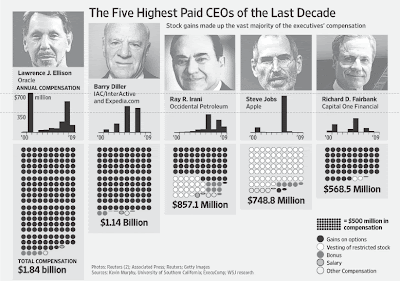
Coming in No. 2 on the compensation list was Barry Diller, who received roughly $1.14 billion from IAC/InterActive and Expedia.com, the online travel site IAC spun off in 2005, where he remains chairman.
Following Mr. Diller were Occidental Petroleum Corp. CEO Ray Irani at $857 million, Apple Inc.'s Steve Jobs with $749 million and, in fifth place, Capital One Financial Corp. CEO Richard Fairbank at $569 million.
Four of the top 25 CEOs worked at financial companies, two on Wall Street: former Lehman Brothers CEO Richard S. Fuld, at No. 11 with $457 million, and former Citigroup Inc. CEO Sandy Weill, who ranked 19th at $361 million. The others were Mr. Fairbank and former Countrywide Financial Corp. CEO Angelo Mozilo.
The Journal analysis includes salaries, bonuses, perks and realized gains on both restricted stock and stock options; it excludes new grants of restricted stock and stock options. The analysis didn't track whether executives sold shares they acquired after they exercised stock options or after previously restricted stock vested.
The survey shows that only some of the best-paid executives in the decade oversaw great stock gains for shareholders.
The size of executive pay packages, and the ways companies try to align executive pay to shareholder returns, became a heated political topic at several points in the last 10 years, especially in the wake of accounting scandals early in the decade and the Wall Street collapse of 2008. Critics say stock options sometimes work too well—pushing executives to make risky moves that lift the stock price in the short run, but ultimately hurt the company.
Oracle shareholders saw the value of their stock triple, while shareholders of Apple saw their stock soar nearly 12 times over. But shareholders of another tech giant, Dell Inc., lost 66% of the value of their stock during the decade, while CEO Michael Dell, who launched the computer maker in his dorm room in the 1980s, brought home $454 million.
Four of the 10 highest-earning executives ran companies whose shareholders lost money over the decade: IAC/InterActive, Countrywide, Capital One and Cendant Corp.
The disparity between those CEOs' fortunes and those of their shareholders is "pretty depressing," and "suggests there's a fair amount of pay without performance," said Jesse Fried, a law professor at Harvard University and co-author of a 2004 book, "Pay Without Performance: The Unfulfilled Promise of Executive Compensation." But Steven Kaplan, a professor at the University of Chicago's Booth School of Business, said that in general, "the guys who got the big payoffs deliver."
Consider Mr. Ellison, a 65-year-old sailing enthusiast who founded Oracle in 1977. In the 10 years ended May 31, 2009, the most recent fiscal year for which Oracle has disclosed pay data, its market capitalization nearly tripled, to $98 billion, from $36 billion.
It has since risen further. Mr. Ellison's 23% stake in Oracle is valued at roughly $28.8 billion. Realized gains on options accounted for 97% of Mr. Ellison's total compensation.
An Oracle spokeswoman declined to comment.
Mr. Diller of IAC and a spokeswoman for Capital One's Mr. Fairbank say their compensation reflects solid returns for shareholders over earlier periods.

For example, Mr. Diller in 2005 exercised more than 22 million IAC and Expedia stock options that had been granted in 1995, recording a paper gain of $463 million; he still holds the shares. Over that period, IAC stock rose more than four-fold.
"I did exactly as well as shareholders during the exact same counting period," Mr. Diller said in an interview. "If you're thinking of alignment with shareholders, I can't imagine a more aligned system."
Mr. Fairbank also recognized big gains from options granted in 1995 and exercised in 2005; he took in $249 million that year, nearly half his total for the decade. Over the period of 1995 to 2005, Capital One shares rose eightfold. Mr. Fairbank hasn't been paid a salary or bonus since 1997, a spokeswoman said.
The stocks of Countrywide and Lehman Brothers, meanwhile, soared for years before the housing slowdown and financial crisis. That allowed Mr. Mozilo, the former CEO of Countrywide, and Mr. Fuld, the former Lehman CEO, to reap big gains on options before their companies faltered.
Mr. Mozilo's attorney, David Siegel, didn't respond to requests for comment. Former Cendant CEO Henry Silverman didn't return calls. Mr. Fuld's attorney, Patricia Hynes, said in an email that the Journal should exclude Mr. Fuld's gains on stock and stock-option grants prior to 2000; she didn't respond to requests for further comment.
Even at some companies that have done well, some shareholders say the CEO is paid too much. Occidental shares rose more than sevenfold in the past decade. But shareholders in May opposed the oil company's executive-pay plan in a nonbinding vote.
Investors who campaigned against Occidental's pay plan say the CEO, Mr. Irani, was paid roughly three times as much as other oil-company executives. They contend the board sets his pay too high and his performance targets too low.
An Occidental spokesman said company directors believe in "excellent pay for excellent performance." Most of Mr. Irani's pay is tied to Occidental's operating results and share price, the spokesman noted, and all of his stock and option awards are now linked either to operating results or share price.
A Dell spokesman said most of Mr. Dell's compensation reflected gains on options granted in the 1990s, when Dell's stock price soared. He noted that Mr. Dell hasn't received a bonus for four years and hasn't been granted stock or stock options for six years.
Changes in executive-pay systems beginning in the 1980s were aimed at better aligning the fortunes of CEOs and their shareholders.
Salaries were restricted and executives were given more of their pay in stock options, which have value only if the company's share price rises.
Stock options give holders the right to buy shares at a specified price, known as the strike price. Options are generally granted for a seven-to-10-year period at a strike price equal to the share price on the grant date. Options accounted for 78% of pay for the top 25 earners in The Wall Street Journal analysis.
Looking at pay over a decade is intended to smooth out year-to-year fluctuations. But there remain mismatches between when pay was awarded and when it was received.
With so much pay linked to stock prices, executives' total compensation in the analysis varied depending on when they realized gains on options or restricted shares. Many of the top-earning executives exercised stock options in years when stock prices were relatively high, such as 2000, 2005 and 2007. Many of those options were granted in the 1990s.
By contrast, compensation for the group fell last year, when few executives exercised options at relatively depressed share prices. Mr. Ellison, for example, gained about $700 million from exercising options in January 2001, when Oracle's stock was near the dot-com era highs. But the following year his pay was almost nil.
The financial-reform bill signed last week by President Barack Obama gives shareholders of all companies a periodic, nonbinding vote on their corporation's executive-pay plan and requires companies to disclose the disparity between the CEO's pay and that of other employees.
Several of the nation's wealthiest executives weren't among the top earners. Warren Buffett of Berkshire Hathaway Inc. receives only nominal compensation. Microsoft Chairman Bill Gates stepped down as CEO in January 2000, and retired as a Microsoft employee in 2008.
Apple's Mr. Jobs also took a $1 annual salary throughout the decade. But he ranked fourth primarily because of a $647 million gain on restricted stock that was granted in 2003 and vested in 2006. He still holds the shares.
Apple directors gave Mr. Jobs the restricted stock in exchange for stock options that were then worthless, but which ultimately would have been worth more than the restricted stock had Mr. Jobs held them. Apple later acknowledged that some of the options exchanged for the restricted shares had been backdated, boosting their value, and restated its financial results. An Apple spokesman declined to comment.
Sixteen of the top 25 executives on the list were at their companies for the full decade, though not always as CEO. The top five headed their companies the entire period.
It was conducted by University of Southern California business professor Kevin Murphy, based on company filings with the Securities and Exchange Commission. Gains on restricted stock are included only for 2006 though 2009; companies didn't have to report them for earlier years.
"I did exactly as well as shareholders during the exact same counting period," Mr. Diller said in an interview. "If you're thinking of alignment with shareholders, I can't imagine a more aligned system."
Mr. Fairbank also recognized big gains from options granted in 1995 and exercised in 2005; he took in $249 million that year, nearly half his total for the decade. Over the period of 1995 to 2005, Capital One shares rose eightfold. Mr. Fairbank hasn't been paid a salary or bonus since 1997, a spokeswoman said.
The stocks of Countrywide and Lehman Brothers, meanwhile, soared for years before the housing slowdown and financial crisis. That allowed Mr. Mozilo, the former CEO of Countrywide, and Mr. Fuld, the former Lehman CEO, to reap big gains on options before their companies faltered.
Mr. Mozilo's attorney, David Siegel, didn't respond to requests for comment. Former Cendant CEO Henry Silverman didn't return calls. Mr. Fuld's attorney, Patricia Hynes, said in an email that the Journal should exclude Mr. Fuld's gains on stock and stock-option grants prior to 2000; she didn't respond to requests for further comment.
Even at some companies that have done well, some shareholders say the CEO is paid too much. Occidental shares rose more than sevenfold in the past decade. But shareholders in May opposed the oil company's executive-pay plan in a nonbinding vote.
Investors who campaigned against Occidental's pay plan say the CEO, Mr. Irani, was paid roughly three times as much as other oil-company executives. They contend the board sets his pay too high and his performance targets too low.
An Occidental spokesman said company directors believe in "excellent pay for excellent performance." Most of Mr. Irani's pay is tied to Occidental's operating results and share price, the spokesman noted, and all of his stock and option awards are now linked either to operating results or share price.
A Dell spokesman said most of Mr. Dell's compensation reflected gains on options granted in the 1990s, when Dell's stock price soared. He noted that Mr. Dell hasn't received a bonus for four years and hasn't been granted stock or stock options for six years.
Changes in executive-pay systems beginning in the 1980s were aimed at better aligning the fortunes of CEOs and their shareholders.
Salaries were restricted and executives were given more of their pay in stock options, which have value only if the company's share price rises.
Stock options give holders the right to buy shares at a specified price, known as the strike price. Options are generally granted for a seven-to-10-year period at a strike price equal to the share price on the grant date. Options accounted for 78% of pay for the top 25 earners in The Wall Street Journal analysis.
Looking at pay over a decade is intended to smooth out year-to-year fluctuations. But there remain mismatches between when pay was awarded and when it was received.
With so much pay linked to stock prices, executives' total compensation in the analysis varied depending on when they realized gains on options or restricted shares. Many of the top-earning executives exercised stock options in years when stock prices were relatively high, such as 2000, 2005 and 2007. Many of those options were granted in the 1990s.
By contrast, compensation for the group fell last year, when few executives exercised options at relatively depressed share prices. Mr. Ellison, for example, gained about $700 million from exercising options in January 2001, when Oracle's stock was near the dot-com era highs. But the following year his pay was almost nil.
The financial-reform bill signed last week by President Barack Obama gives shareholders of all companies a periodic, nonbinding vote on their corporation's executive-pay plan and requires companies to disclose the disparity between the CEO's pay and that of other employees.
Several of the nation's wealthiest executives weren't among the top earners. Warren Buffett of Berkshire Hathaway Inc. receives only nominal compensation. Microsoft Chairman Bill Gates stepped down as CEO in January 2000, and retired as a Microsoft employee in 2008.
Apple's Mr. Jobs also took a $1 annual salary throughout the decade. But he ranked fourth primarily because of a $647 million gain on restricted stock that was granted in 2003 and vested in 2006. He still holds the shares.
Apple directors gave Mr. Jobs the restricted stock in exchange for stock options that were then worthless, but which ultimately would have been worth more than the restricted stock had Mr. Jobs held them. Apple later acknowledged that some of the options exchanged for the restricted shares had been backdated, boosting their value, and restated its financial results. An Apple spokesman declined to comment.
Sixteen of the top 25 executives on the list were at their companies for the full decade, though not always as CEO. The top five headed their companies the entire period.
It was conducted by University of Southern California business professor Kevin Murphy, based on company filings with the Securities and Exchange Commission. Gains on restricted stock are included only for 2006 though 2009; companies didn't have to report them for earlier years.
Wednesday, July 14, 2010
Former CEOs Join Ranks of Unemployed
The Wall Street Journal

Anne Stevens is among a growing number of job-hunting former CEOs.
Nowadays, former chief executive Anne Stevens spends time job hunting and making créme caramel in the kitchen of her 13,400-square-foot home in this Philadelphia suburb.
Nine months after leaving the highest job at Carpenter Technology Corp., she typically devotes at least three hours a day making calls to company executives, recruiters and professional contacts. A board member at Lockheed Martin Corp. and one-time Ford Motor Co. executive, Ms. Stevens faces a job market unusual in the exclusive ranks of top executives—but not unfamiliar to many Americans.
"There just aren't a lot of [CEO] searches out there," she says.
No one knows how many out-of-work CEOs are looking for corner office suites, but recruiters say their numbers are growing. Fewer big businesses are switching bosses these days and mergers and bankruptcies have further reduced their job prospects. Only 48 companies in the S&P 500 index changed leaders last year, the lowest level since recruiters Spencer Stuart began tracking it in 2004.
Replacement of big-business CEOs picked up in the second quarter, according to Spencer Stuart. But it will take more than a slight gain to find good homes for every unemployed chief. Just two of 13 major corporations switching leaders in the latest quarter chose an outsider.
Some boards are loath to change chiefs during economic turbulence, and the choppy recovery so far hasn't sufficiently heartened boards, recruiters say.
Big-company mergers have eliminated dozens of senior management jobs, too. Jonathan Schwartz, the former chief at Sun Microsystems, now owned by Oracle Corp., and Todd Stitzer at Cadbury, now owned by Kraft Foods Inc. are among those hoping to be CEOs elsewhere. Mr. Stitzer says he has flirted with several mid-sized U.S. concerns about taking their helm.
"We have a much higher flow of former CEOs than we have seen in many years looking for a position again at the CEO level," says James G. Aslaksen, a senior client partner for recruiters Korn/Ferry International. He finds these job hunts can now last 18 months, up from no more than a year in 2005. Among major corporations, however, "the [CEO] opportunity pool is fairly small," adds Dennis Carey, also of Korn/Ferry.
Smaller companies have started to look for new CEOs again, recruiters report. But many former corporate chiefs want another big-company post.
Carlos Gutierrez, a former Kellogg Co. CEO who resigned as U.S. Commerce secretary early last year, desires to run a public company with at least $14 billion in annual revenue. He says he's spurned feelers about running concerns that he felt were too small, headquartered abroad or privately owned.
Chiefs with controversies on their resumes face high hurdles. Mike Zafirovski left Nortel Networks Corp. last August amid a dismantling of the fallen technology giant following a bankruptcy-court filing. He prefers to lead another large business and has prepared a detailed, two-page chart of his career financial-feats, according to someone familiar with the matter.
Mr. Zafirovski spent more than three years trying to turn Nortel around, but critics say he didn't move fast enough. Its bankruptcy hurts his job hunt, according to recruiters.
Ms. Stevens, now 61, was a first-time CEO when Carpenter, a developer and maker of specialty alloys, hired her in November 2006. The nursing-school dropout had received her engineering degree at age 30. She spent a decade working for Exxon Corp., then joined Ford as a business planner in 1990.
She eventually advanced to chief operating officer for the Americas, overseeing more than $75 billion in annual revenue. That made Ms. Stevens the highest ranked woman in the U.S. automotive industry.
She managed the Detroit auto maker's tricky vehicle recalls and plant shutdowns following the turmoil after September 11, 2001. Bill Ford Jr., Ford's executive chairman and previous CEO, says Ms. Stevens played a key role in crafting a North American turnaround plan.
Ms. Stevens even aspired to run Ford. Once she turned 57, however, "age was running against me," she recalls. "To go for my dream, I had to leave."
So eager was she to be a CEO that she took the first helm offered—at Carpenter. Its headquarters in her hometown of Reading, Pa., made the job even more appealing. As a result, she says, she "didn't probe deep enough" into its boardroom personalities, customers, products and operations.
"I didn't realize how much [Carpenter] lacked structure and systems," Ms. Stevens says. "If I knew then what I know now, I would have never taken the job."
Carpenter achieved record results during her first two years, as Ms. Stevens sold assets, enlarged melting facilities and shook up senior management. But profits and sales slipped in the fiscal year ended June 2009.
Ms. Stevens says she "found it difficult to build a close relationship" with fellow directors. The stressful situation often woke her up at night. Board members opposed her strategy to expand the company during the downturn, she remembers. In summer 2009, the board stripped her of the chairman's title. She soon quit.
Splitting the top roles "was an emerging practice," says Gregory Pratt, an outside director who now is chairman. Board members appreciate "the improvements she made in Carpenter's business" and she "was an excellent CEO," Mr. Pratt adds. He says Ms. Stevens never told him she had significant concerns about board communications.
As she seeks work in the U.S. or abroad, Ms. Stevens is getting assistance from Mr. Aslaksen and his colleagues. Boards needing a new chief often value a battle-tested executive like Ms. Stevens, suggests Mr. Carey, a Korn/Ferry vice chairman.
Ms. Stevens has also approached private-equity firms about leading a small portfolio company.
Despite her search, Ms. Stevens has yet to score any face-to-face interviews. "It is going to be a challenge" for Ms. Stevens to find another CEO post because the huge supply of potential chiefs enables boards to overlook "anyone who has any taint of controversy," says Judith von Seldeneck, head of Diversified Search Odgers Berndtson.
The unemployed chief executive keeps busy serving on the Lockheed Martin board, caring for a sick friend – and knitting afghans.
Yet Ms. Stevens was so sure her next corner office would require relocation that she put her French country-style home up for sale in November."I don't need a house that big," she observes. "I used the house a lot for entertaining while I was CEO."
Nine months after leaving the highest job at Carpenter Technology Corp., she typically devotes at least three hours a day making calls to company executives, recruiters and professional contacts. A board member at Lockheed Martin Corp. and one-time Ford Motor Co. executive, Ms. Stevens faces a job market unusual in the exclusive ranks of top executives—but not unfamiliar to many Americans.
"There just aren't a lot of [CEO] searches out there," she says.
No one knows how many out-of-work CEOs are looking for corner office suites, but recruiters say their numbers are growing. Fewer big businesses are switching bosses these days and mergers and bankruptcies have further reduced their job prospects. Only 48 companies in the S&P 500 index changed leaders last year, the lowest level since recruiters Spencer Stuart began tracking it in 2004.
Replacement of big-business CEOs picked up in the second quarter, according to Spencer Stuart. But it will take more than a slight gain to find good homes for every unemployed chief. Just two of 13 major corporations switching leaders in the latest quarter chose an outsider.
Some boards are loath to change chiefs during economic turbulence, and the choppy recovery so far hasn't sufficiently heartened boards, recruiters say.
Big-company mergers have eliminated dozens of senior management jobs, too. Jonathan Schwartz, the former chief at Sun Microsystems, now owned by Oracle Corp., and Todd Stitzer at Cadbury, now owned by Kraft Foods Inc. are among those hoping to be CEOs elsewhere. Mr. Stitzer says he has flirted with several mid-sized U.S. concerns about taking their helm.
"We have a much higher flow of former CEOs than we have seen in many years looking for a position again at the CEO level," says James G. Aslaksen, a senior client partner for recruiters Korn/Ferry International. He finds these job hunts can now last 18 months, up from no more than a year in 2005. Among major corporations, however, "the [CEO] opportunity pool is fairly small," adds Dennis Carey, also of Korn/Ferry.
Smaller companies have started to look for new CEOs again, recruiters report. But many former corporate chiefs want another big-company post.
Carlos Gutierrez, a former Kellogg Co. CEO who resigned as U.S. Commerce secretary early last year, desires to run a public company with at least $14 billion in annual revenue. He says he's spurned feelers about running concerns that he felt were too small, headquartered abroad or privately owned.
Chiefs with controversies on their resumes face high hurdles. Mike Zafirovski left Nortel Networks Corp. last August amid a dismantling of the fallen technology giant following a bankruptcy-court filing. He prefers to lead another large business and has prepared a detailed, two-page chart of his career financial-feats, according to someone familiar with the matter.
Mr. Zafirovski spent more than three years trying to turn Nortel around, but critics say he didn't move fast enough. Its bankruptcy hurts his job hunt, according to recruiters.
Ms. Stevens, now 61, was a first-time CEO when Carpenter, a developer and maker of specialty alloys, hired her in November 2006. The nursing-school dropout had received her engineering degree at age 30. She spent a decade working for Exxon Corp., then joined Ford as a business planner in 1990.
She eventually advanced to chief operating officer for the Americas, overseeing more than $75 billion in annual revenue. That made Ms. Stevens the highest ranked woman in the U.S. automotive industry.
She managed the Detroit auto maker's tricky vehicle recalls and plant shutdowns following the turmoil after September 11, 2001. Bill Ford Jr., Ford's executive chairman and previous CEO, says Ms. Stevens played a key role in crafting a North American turnaround plan.
Ms. Stevens even aspired to run Ford. Once she turned 57, however, "age was running against me," she recalls. "To go for my dream, I had to leave."
So eager was she to be a CEO that she took the first helm offered—at Carpenter. Its headquarters in her hometown of Reading, Pa., made the job even more appealing. As a result, she says, she "didn't probe deep enough" into its boardroom personalities, customers, products and operations.
"I didn't realize how much [Carpenter] lacked structure and systems," Ms. Stevens says. "If I knew then what I know now, I would have never taken the job."
Carpenter achieved record results during her first two years, as Ms. Stevens sold assets, enlarged melting facilities and shook up senior management. But profits and sales slipped in the fiscal year ended June 2009.
Ms. Stevens says she "found it difficult to build a close relationship" with fellow directors. The stressful situation often woke her up at night. Board members opposed her strategy to expand the company during the downturn, she remembers. In summer 2009, the board stripped her of the chairman's title. She soon quit.
Splitting the top roles "was an emerging practice," says Gregory Pratt, an outside director who now is chairman. Board members appreciate "the improvements she made in Carpenter's business" and she "was an excellent CEO," Mr. Pratt adds. He says Ms. Stevens never told him she had significant concerns about board communications.
As she seeks work in the U.S. or abroad, Ms. Stevens is getting assistance from Mr. Aslaksen and his colleagues. Boards needing a new chief often value a battle-tested executive like Ms. Stevens, suggests Mr. Carey, a Korn/Ferry vice chairman.
Ms. Stevens has also approached private-equity firms about leading a small portfolio company.
Despite her search, Ms. Stevens has yet to score any face-to-face interviews. "It is going to be a challenge" for Ms. Stevens to find another CEO post because the huge supply of potential chiefs enables boards to overlook "anyone who has any taint of controversy," says Judith von Seldeneck, head of Diversified Search Odgers Berndtson.
The unemployed chief executive keeps busy serving on the Lockheed Martin board, caring for a sick friend – and knitting afghans.
Yet Ms. Stevens was so sure her next corner office would require relocation that she put her French country-style home up for sale in November."I don't need a house that big," she observes. "I used the house a lot for entertaining while I was CEO."
Wednesday, April 8, 2009
Wagoner's Eviction from GM Serves Notice to Other CEOs
Story from the Wall Street Journal
 If any U.S. banks need more cash from the government, they might have to sacrifice their chief executive to get it.
The Obama administration's ouster of General Motors Corp. CEO Rick Wagoner under the threat of withholding more bailout money underscored the potential pressure on top executives of large banks being evaluated by Treasury Department stress tests to see if they need additional capital.
Treasury Secretary Timothy Geithner said Sunday that s ome financial institutions would be found lacking as a result of the examinations. If those banks can't raise the money from private investors and so turn to the government, the jobs of some chief executives could be on the line, according to some bank analysts and lawyers.
Asked whether another round of government help following the stress tests would trigger regulatory encouragement to fire executives, Jeff Davis, the director of research at Howe Barnes Hoefer & Arnett Inc. said: "Emphatically, yes."
"You've got to figure it is coming," Mr. Davis said.
Banks are much more tightly regulated than automobile manufacturers, and it isn't unusual for bank regulators to demand changes in top management. But those changes are usually done discreetly, by pushing the board to fire the CEO, said Sanford Brown, a managing partner with law firm Bracewell & Giuliani LLP who served in the Office of the Comptroller of the Currency during the late 1980s.
"Regulators usually don't make overt demands," he said.
In addition, while CEO dismissals might satisfy public outrage at bankers, such moves could deepen concerns among investors, said Kip A. Weissman, a partner at Luse Gorman Pomerenk & Schick PC. "It would be a massive vote of non-confidence " in the banking industry, he said.
Among the bank CEOs considered vulnerable by some analysts and investors are C. Dowd Ritter, chairman and chief executive of Regions Financial Corp., a regional bank based in Birmingham, Ala. Regions is struggling with rising losses tied to commercial and residential real-estate loans.
A bank spokesman said Monday: "Regions remains well capitalized and we do not see a correlation with what is going on with the U.S. auto industry."
Like Mr. Wagoner of GM, Mr. Ritter led his company during the period leading up to its financial troubles.
Subscribe to:
Posts (Atom)