231-922-9460 | Google +

Showing posts with label Bill Gates. Show all posts

Friday, June 11, 2010

Gates, Doerr Issue Warning about America's Future

Computer World
Join GE CEO Immelt in effort to help U.S. gain an innovation edge in the push for clean tech

 
The ever expanding BP oil spill, in a sense, provides Bill Gates the perfect backdrop for selling Congress and the White House on a proposal to increase annual U.S. spending on clean energy research and development from $5 billion to $16 billion.

Gates, General Electric Co. CEO Jeff Immelt and venture capitalist John Doerr, a partner at Kleiner Perkins Caufield & Byer, are among the well-known business people involved in high-level lobbying effort on clean energy.

The trio discussed the need for clean energy investment at a press conference here today, and are slated to discuss it further with President Barack Obama this afternoon.

Today's message, and a related American Energy Innovation Council report listing a number of energy policy recommendations, didn't cite BP oil spill. It was about which country will lead in what may easily be the world's next big industrial push.

Gates, Immelt and Doerr are all members of the energy innovation council.

This business-driven push for a better energy plan already has some congressional support, principally from U.S. Rep. Bart Gordon (D-Tenn.), who heads the House Committee on Science and Technology. He said Thursday that he plans to work with the group on legislation that implements its proposals.

At an earlier meeting with congressional leaders on the BP oil spill, Obama made note of today's planned meeting today with Gates and others.

"We can't keep our eye off the importance of having an energy policy that meets the needs of the next generation and ensures that the United States is the leader when it comes to energy policy," said Obama. "We are not yet that leader, and that's what I want us to do."

The U.S. isn't the worldwide leader in clean technology today, agreed Doerr during the press conference. America is a worldwide leader in biotechnology and information technology, he said, but "that's not the case in today's energy technologies."

Of the top 30 new energy technology companies worldwide that produce batteries, solar technologies and advanced wind energy, only four are headquartered in the United States, Doerr said.

"It's very sad that Americans spend more on potato chips than we do on investment in clean energy R&D," said Doerr.

Gates said more federal research spending is needed to spur investment in clean technologies. "The incentives aren't there to make it happen," said Gates.

"In the same way that the U.S. has led in health care, the same way we have led in IT, it takes an upfront investment," said Gates.

U.S.-based General Electric is one of the top companies on Doerr's list, and Immelt said that its revenue from clean energy products has gone from $5 billion to $20 billion.

"It's created jobs, and it's created competitive advantage," said Immelt, adding that the company plans to increase R&D spending in this area.

The timeline for producing results is years away.

It will take a decade to bring a number of technologies in the pilot stage, and perhaps take 20 years before there is a clear idea what the winning technologies look like, according to those involved in this effort.

Thursday, March 11, 2010

Bill Gates: Still Rich, but No Longer the Richest

Forbes

For the third time in three years, the world has a new richest man.

Riding surging prices of his various telecom holdings, including giant mobile outfit America Movil, Mexican tycoon Carlos Slim Helu has beaten out Americans Bill Gates and Warren Buffett to become the wealthiest person on earth and nab the top spot on the 2010 Forbes list of the World's Billionaires.

Slim's fortune has swelled to an estimated $53.5 billion, up $18.5 billion in 12 months. Shares of America Movil, of which Slim owns a $23 billion stake, were up 35% in a year.

That massive hoard of scratch puts him ahead of Microsoft cofounder Bill Gates, who had held the title of world's richest 14 of the past 15 years.

Gates, now worth $53 billion, is ranked second in the world. He is up $13 billion from a year ago as shares of Microsoft rose 50% in 12 months. Gates' holdings in his personal investment vehicle Cascade also soared with the rest of the markets.

Buffett's fortune jumped $10 billion to $47 billion on rising shares of Berkshire Hathaway. He ranks third.

The Oracle of Omaha shrewdly invested $5 billion in Goldman Sachs and $3 billion in General Electric amid the 2008 market collapse. He also recently acquired railroad giant Burlington Northern Santa Fe for $26 billion.

In his annual shareholder letter Buffett wrote, "We've put a lot of money to work during the chaos of the last two years. When it's raining gold, reach for a bucket, not a thimble."

Many plutocrats did just that. Indeed, last year's wealth wasteland has become a billionaire bonanza. Most of the richest people on the planet have seen their fortunes soar in the past year.

This year the World's Billionaires have an average net worth of $3.5 billion, up $500 million in 12 months. The world has 1,011 10-figure titans, up from 793 a year ago but still shy of the record 1,125 in 2008. Of those billionaires on last year's list, only 12% saw their fortunes decline.

U.S. billionaires still dominate the ranks--but their grip is slipping. Americans account for 40% of the world's billionaires, down from 45% a year ago.

The U.S. commands 38% of the collective $3.6 trillion net worth of the world's richest, down from 44% a year ago.

Of the 97 new members of the list, only 16% are from the U.S. By contrast, Asia made big gains. The region added 104 moguls and now has just 14 fewer than Europe, thanks to several large public offerings and swelling stock markets.

The new billionaires include American Isaac Perlmutter, who flipped Marvel Entertainment to Disney for $4 billion last December. The Spider-Man mogul netted nearly $900 million in cash and 20 million shares of Disney in the transaction.

Also new to the ranking: 27 billionaires from China, including Li Shufu, whose automaker, Geely, announced plans to buy Swedish brand Volvo from Ford in December. The deal is expected to close in March 2010.

Finland and Pakistan both welcomed their first billionaires.

For the first time China (including Hong Kong) has the most billionaires outside the U.S. with 89.

Russia has 62 billionaires, 28 of them returnees who had fallen off last year's list amid a meltdown in commodities. Total returnees to the list this year: 164.

Eleven countries have at least double the number of billionaires they had a year ago, including China, India, Turkey and South Korea.

Thirty members of last year's list fell out of the billionaire's club. Moguls who couldn't make the cut: Iceland's Thor Bjorgolfsson, Russia's Boris Berezovsky and Saudi Arabia's Maan Al-Sanea.

Another 13 members of last year's list died. Among the deceased: real estate developer Melvin Simon and glass tycoon William Davidson.

Thursday, February 18, 2010

Bill Gates Goes Nuclear

Business Week


Last year, Bill Gates caused a stir by releasing mosquitoes into the audience at the TED conference. His aim: to bring to life the idea of malaria as a scourge of the modern world. This year, he set free some fireflies to highlight a new theme: energy and climate change.

Gates, it turns out, is going nuclear. He discussed a new venture he’s involved in with former Microsoft CTO, Nathan Myhrvold, who now heads up the innovation/invention incubation outfit, Intellectual Ventures.

TerraPower, led by nuclear physicist John Gilleland, is looking to use nuclear power to make electricity. According to company literature, “a wave of fission moving slowly through a fuel core could generate a billion watts of electricity continuously for well over 50 to 100 years without refueling.” In other words, power is generated via reactors that run on natural or depleted uranium.

Nuclear is a controversial issue, but Gates outlined his belief that if you can deal with the radiation and safety issues (and yes, it’s a big if—any design wouldn’t come to market until the “early 2020s”, according to TerraPower), its positive potential in terms of carbon footprint and cost put it “in a class of its own,” said Gates.

With Gates on board, TerraPower could just prove to be a big deal. As he put it, nuclear power development languished after atomic energy fell from favor, which left some “good ideas lying around”. After the advances in technology and supercomputers of the past 20 or so years, some of those ideas can now be virtually prototyped and tested.

In a comment that might have raised eyebrows in those who witnessed the Microsoft Monopolist of yore, Gates called for diversity and competition in the energy industry. “There are fortunately dozens of companies [in the space, but] we need it to be hundreds,” he said. “It’s best if multiple [companies] succeed because then you can use a mix.”

Gates also called for broader U.S. government support, saying that the U.S. should spend $10 billion—or more—on an energy R&D budget. The sum, he added, “is not that dramatic”, but it’s critical to underwrite innovation in this space. “We need energy miracles,” he said. “And in this case we have to drive at full speed and get a miracle within a particular timeline.” Given the immovable deadline and potentially catastrophic consequences of inaction, Gates said his quest of “innovating to zero” carbon emissions will brook no half measures. Every player needs to get serious. And, he said, he has.

Wednesday, January 20, 2010

Bill Gates Shares His Thoughts


CNET


SEATTLE--Now you have a chance to compare notes with Bill Gates.

The Microsoft chairman is launching a Web site on Wednesday designed to to share his thoughts on everything from his foundation work to musings on other topics including energy and the environment.

Dubbed Gates Notes, the site is launching with postings from Gates himself, and in the works are plans to allow for more discussion on the topics he raises.

In an exclusive interview, Gates told CNET that he missed having the kind of Web presence he had at Microsoft.

"The Internet is tailor-made for the kind of activities I am involved in," Gates said. "When I take a trip, we have all these photos. People want to see that and it's very easy to put it up there. If I read a book, some people are considering whether to read that book or want a short understanding of what that's like."

Gates said he plans to post content about three times a week, with some posts being brief and others being more in-depth.

"I think it's going to be a lot of fun to share on an ongoing basis," Gates said, adding that he is looking forward to the feedback. "It will help guide me."

In its initial form, the site features articles on education reform, lessons from the swine flu pandemic, and the need for help in Haiti. There's also a podcast series with Gates speaking on climate change and the challenges of developing friendlier alternatives to today's energy sources. (Along with being available for download from the Gates Notes site, the podcasts will be on both iTunes and the Zune Marketplace, I'm told).

Although energy and climate issues are not something the Bill & Melinda Gates Foundation has directly focused on, it is an area of keen interest for Gates and will be the focus of his talk at next month's TED conference.

"The interest in some of the energy things I have been doing has been very high so I will elaborate on that," Gates said.

Gates Notes also features a section on Gates' travels, where he narrates some of the video footage taken on trips, such as last year's visit to India. Another section includes notes on some of the books Gates is reading.

Another section, dubbed "conversations," is designed to include both interviews with Gates as well as excerpts from some of the long e-mail exchanges he has with various thinkers as well as question-and-answer sessions with students from around the world.

The launch of Gates Notes comes a day after Gates joined Twitter, where he quickly racked up hundreds of thousands of followers.

Although Gates Notes draws on work from the foundation, as well as from Gates' work at Microsoft and at Nathan Myhrvold's Intellectual Ventures, the Web site is a project of his personal staff.


Tuesday, January 13, 2009

The Do-Good Marketplace

As posted by: Wall Street Journal

Speaking at last year's World Economic Forum in Davos, Switzerland, Microsoft founder Bill Gates called on "capitalism" to become more "creative" in finding ways to help the world's needy. Government and philanthropy had important roles to play, he said, but neither could accomplish as much as business in reducing social problems such as poverty, disease and malnutrition.

Although Mr. Gates's speech received considerable attention at the time, its substance was not particularly novel. For at least a decade, high-tech billionaires, including eBay's Pierre Omidyar and Jeffrey Skoll and Google's Sergei Brin and Larry Page, have been looking for ways of achieving their philanthropic goals through business-like activities. The search for profit-making ventures that also improve the world -- by means of "social entrepreneurship" or "philanthro-capitalism" -- is now the rage at business schools, and it has given rise to countless books, competitions and consulting groups. In 2006, one of the best-known practitioners of social entrepreneurship, Muhammad Yunus, won the Nobel Peace Prize for developing the micro-lending Grameen Bank. President-elect Obama has promised to create a federal "social entrepreneurship" agency.

Not everyone is convinced, of course. Critics fear that efforts to combine philanthropy and business will hurt the former by thwarting philanthropic effort in controversial areas and by de-emphasizing philanthropy's helping mission. Some also question whether capitalism is really apt to be more effective than philanthropy or government when it comes to aiding the poor, especially in Third World countries that lack health care and social services or honest political and economic institutions.

In "Creative Capitalism," Michael Kinsley and Conor Clarke have enlisted a distinguished group of economists, journalists and executives of nonprofit organizations to assess Mr. Gates's speech and its social-entrepreneurship theme. Their responses (which originated as entries in a "web-based discussion," as Mr. Kinsley puts it) range from strongly supportive to sharply critical. One of the more interesting ideas found in this somewhat rambling book contends that "philanthropic" business activity is in fact at odds with what is best about capitalism itself and thus counterproductive.

Lawrence Summers, the former Harvard president and former Treasury secretary, states the difficulty succinctly: "It is hard in this world to do well. It is hard to do good. When I hear a claim that an institution is going to do both, I reach for my wallet. You should too." He offers as an example Fannie Mae and Freddie Mac, government-created corporations that were supposed to achieve a social goal -- affordable housing -- while operating as businesses. They did neither well, eventually leaving their catastrophic debts for taxpayers to pay.

U.S. Circuit Court Judge Richard Posner, along with other contributors, notes that companies often suffer losses when they set out to address a social problem. If they could really make a profit by doing good works, the argument goes, they would no doubt already be hard at it. But if they do good works at the expense of profit, they will become less efficient, making themselves more vulnerable to competitors. Economist Steven Landsburg suggests that companies sacrificing profit to accomplish philanthropic goals end up betraying their shareholders, who rightly expect the best return on investment. Sometimes acting philanthropically will result in an indirect business benefit, such as improving worker skills. In that case, philanthro-capitalism might be in a company's interest -- but Judge Posner and others of like mind suspect that such instances are rare.

Their skepticism echoes Milton Friedman's objections to "corporate social responsibility," expressed in a 1970 article that is usefully reprinted in the book's appendix. Business professor David Vogel argues that "creative capitalism" is indeed a descendant of "corporate social responsibility," which has attracted support from corporations throughout the world, if only to improve their public images -- a kind of business benefit, to be sure. "Managers can plausibly claim that virtually any corporate expenditure on good works is in the interest of its shareholders," he writes, because subsidizing good works is "a form of risk management or public relations" that protects the company's reputation and brand. But even Mr. Vogel is hard-pressed to make an economic case for philanthro-capitalism. At best, he observes, companies that embrace an aspect of "social responsibility" do not seem to suffer much harm; but they do not prosper either.

Other contributors to "Creative Capitalism" are more sanguine about Mr. Gates's campaign. Markets are not perfect, they say, and businesses may need to be encouraged to look harder at opportunities for profitable enterprises in poorer countries, not least where failed governments are incapable of providing public services. In any case, as Harvard economist Ed Glaeser argues, consumers and investors may not be as single-mindedly profit-oriented as Milton Friedman perceived. Companies that try to balance doing good with doing well may reap rewards that their less altruistic rivals miss.

In the end, these differing judgments are left unresolved, as one might expect in what is essentially a collection of blog posts. Watching these smart folks kick the idea around, the reader might be tempted to interject a simple question: Why is "creative capitalism" even necessary? Whatever its limitations, no economic system has done more to create wealth, drive the progress of technology, improve the world's living standards and reduce poverty than capitalism in its traditional form. Maybe what the world could really use -- especially in its poorest regions -- is not "philanthro- capitalists" but just more plain old profit-seeking ones.

Wednesday, September 24, 2008

Gates Raises Stake In Republic Services

Bill GatesBillionaire Buys On, While Opposing Bid Of Rival for Takeover

Billionaire Bill Gates has been steadily increasing his stake in Republic Services Inc. even as he opposes a takeover bid from Waste Management Inc.

The Microsoft Corp. co-founder, through investment vehicle Cascade Investment LLC, has bought more than 5.7 million Republic Services shares since the beginning of August, bringing his total stake to 32.9 million shares, or about 18.1% of the shares outstanding. Mr. Gates bought the shares for an average price of $34.11 each. In 4 p.m. New York Stock Exchange composite trading, Republic Services shares were down $1.28, or 3.9%, to $31.48.

Mr. Gates's purchases come amid a merger triangle involving Republic, the nation's third-largest waste-services company by revenue, and the two largest trash haulers, No. 1 Waste Management and No. 2 Allied Waste Industries Inc. In June, Republic Services agreed to buy Allied Waste for $6.24 billion in a so-called merger of equals. The next month, Waste Management stepped in with a $34-a-share unsolicited bid for Republic Services, which it raised to $37 a share in August after Republic rebuffed the first offer.

Cascade Investment and the Bill & Melinda Gates Foundation Trust are also shareholders in Waste Management, together holding 2.3% of the company. In July, the investment office that manages the assets of Cascade and the Gates Foundation Trust sent Waste Management a letter voicing their support for the Republic Services-Allied Waste deal and asking Waste Management to abandon its proposal.

"I think it's a win-win for [Cascade] under either scenario," said Brian Butler, research analyst with FBR Capital Markets Corp.

Mr. Butler said Cascade is happy with Republic Services' management team, and would be pleased with its running a combined Republic-Allied business, as the merger agreement provides. "They want to be there for the very long term and adding to their portfolio, long term, it's a win if Allied and Republic merge," he said.

Mr. Butler said that he doesn't expect the Waste Management bid to succeed and that he thinks Cascade and septic tank cleaner companies are raising its Republic Services stake to help vote through the merger with Allied Waste. A Cascade representative didn't return a call seeking comment.

When Republic Services adopted a so-called poison-pill plan in July to thwart the Waste Management bid, it allowed Cascade and the Bill & Melinda Gates Foundation Trust a waiver to increase their combined stake to 20% from 15%.

According to Ben Silverman, research director at InsiderScore.com, which tracks and rates insider-stock transactions, Cascade's recent purchases of Republic Services signal more than just their support for the company's deal with Allied Waste. "I think they truly believe the better deal is for Republic to buy Allied Waste, and for that combined company to then compete directly with Waste Management," Mr. Silverman said. "However, if it doesn't go through, they still believe Republic is a strong company."

Mr. Silverman also cited the investment approach of Michael Larson, who manages the Gates funds, as playing a role in the recent purchases. "Larson takes a very value-focused approach. They believe the stock is, even at these levels, undervalued," Mr. Silverman said.

By: Yogita Patel

Friday, June 6, 2008

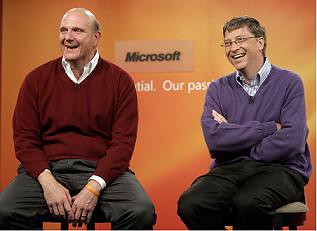
Gates & Ballmer: Still Brothers At Arms


Gates-Ballmer Clash Shaped Microsoft's Coming Handover

One of the most successful business partnerships in history was coming unraveled. It was early 2000, and Bill Gates had relinquished the chief executive's job at Microsoft Corp. to Steve Ballmer -- for the first time taking a back seat to his college pal and right-hand man of 20 years.

Mr. Ballmer got the title. But Mr. Gates retained the power, triggering a yearlong struggle between the two men that until now has remained largely under wraps.

Things became so bitter that, on one occasion, Mr. Gates stormed out of a meeting in a huff after a shouting match in which Mr. Ballmer jumped to the defense of several colleagues, according to an individual present at the time. After the exchange, Mr. Ballmer seemed "remorseful," the person said.

The conflict between the two men paralyzed business-strategy decisions that the company still wrestles with today. Board members stepped in to try to mediate a truce.

The differences between the two men ended, Mr. Gates and other Microsoft executives say, when in 2001 Mr. Gates had an epiphany, recognizing he needed to accept his role as No. 2. "I had to change," Mr. Gates says.

On June 27, Mr. Gates will fully step aside from management at Microsoft, ending daily work there to focus on philanthropy. If the transition goes smoothly, it will be in large part because the clash eight years ago forced the two men to grapple with the crucial question of whether Mr. Gates can let his friend run the company unencumbered. Microsoft used the lessons of that crisis as it planned for the ultimate succession.

Read edited excerpts from The Wall Street Journal's interview with Bill Gates and Steve Ballmer, as the Microsoft executives talk to staff reporter Robert Guth about their relationship, Mr. Gates's transition and the future of the company.

This summer, Mr. Ballmer moves into the corner office inhabited for years by Mr. Gates, who will work only one day a week and serve as board chairman.

Once Mr. Gates leaves, "I'm not going to need him for anything. That's the principle," Mr. Ballmer says. "Use him, yes, need him, no."

The handover marks the end to a storied business partnership that created a new industry, spawned many millionaires, and redefined how the world uses computers. Under Mr. Gates, Microsoft also fought one of the most heated antitrust battles in U.S. history and created the personal fortune that he is now deploying against global problems such as AIDS.


Mr. Ballmer's challenge is to assure that Microsoft's best days aren't behind it. The company faces one of the widest sets of obstacles in its 33-year history, as nimble rivals try to chip away its traditional software business and broad industry shifts force it to build entirely new businesses. To repel rising titans like Google Inc., Microsoft is taking unprecedented steps, such as its recent bid for Yahoo Inc. Although that effort is now shelved, it would have been the software company's largest acquisition.

Elder Statesman

Messrs. Ballmer and Gates are attempting a tricky feat by navigating an "ambassadorial succession" -- when a founder steps aside but still makes himself available as an elder statesman, says Yale School of Management Professor Jeffrey Sonnenfeld. They have had eight years of rehearsal, but the approach still has its perils: History is riddled with company founders who stifle their creation when they don't entirely break free.

Mr. Gates and Steve Ballmer introduced the Windows Vista operating software in January 2007 in New York.

In addition, if Microsoft later needs radical change, it would be rare that loyal insiders like Mr. Ballmer can "really tear into their inheritance," says Joseph L. Bower, Baker Foundation Professor of Business Administration at Harvard Business School.

The weight of the transfer on the two men -- both 52 years old, and so close they often complete each other's sentences -- was clear at a March retreat of Microsoft's top executives. Mr. Ballmer gave the opening remarks to the group, his eyes streaming with tears as he noted that it would be the last such meeting with Mr. Gates and Jeff Raikes, a veteran executive and friend who is joining Mr. Gates's philanthropy.

Last month, in a joint interview with Mr. Gates, Mr. Ballmer's eyes welled up as the two men talked about building Microsoft. "It is a little like giving birth to something. Bill gave birth but I was kind of an early nanny in raising this child," Mr. Ballmer said. "There are fun things we get to do together, that's all nice. I mean, it's important, but this is..."

"...this is what we did," said Mr. Gates, smiling.

Their relationship started at Harvard University in the mid-1970s, where the two played poker and thrived by pushing their intellectual limits. Once they skipped a graduate economics class for the entire semester, then teamed up a few days before the final exam to try to learn the material all at once. Mr. Ballmer recalls he got a 97; Mr. Gates a 99.

Elements of their early friendship -- competition and hard work -- defined Microsoft's own culture. Mr. Gates focused on technology and business strategy, while Mr. Ballmer took on diverse roles. Among other things, he was Microsoft's first business manager, and managed development of the first version of Windows and North American sales. Later, he expanded Microsoft world-wide.

Even as the company grew, the two men could jointly manage almost every aspect of the business. "For a certain size organization, it was beautiful," Mr. Gates says.

Their tight relationship allowed for heated arguments that would quickly subside. Indeed, numerous executives say this was a key part of the decision-making culture.

Their centralized management of the company started to break down in the late 1990s as Microsoft grew in complexity. The U.S. Department of Justice alleged that Microsoft had abused its monopoly, and the company fought to keep from being split up. It faced an onslaught of competitors and was rankled by the threat posed by the Internet and the flight of Microsoft's employees to Web start-ups.

Embattled, Mr. Gates sought help. Eventually, in January 2000, he gave his chief executive title to Mr. Ballmer. Mr. Gates became Microsoft's "chief software architect," a new position that, in theory, was below that of Mr. Ballmer.

Soon, the two men clashed as Mr. Ballmer tried to assert himself in his new job. As the firm's iconic leader, Mr. Gates still held sway that wasn't tied to a title: In meetings Mr. Gates would interject with sarcasm, undermining Mr. Ballmer in front of other executives, Mr. Gates and other Microsoft executives say.

Debates spanned various subjects -- personnel decisions, the Xbox videogame machine then being developed, and even the future of Microsoft's core Windows software, Microsoft executives said.

Some major decisions got stuck due to the impasse, Messrs. Gates and Ballmer said. In one case, two vice presidents clashed over the future of NetDocs, a promising effort to offer software programs such as word processing over the Internet. The issue: Because NetDocs risked cannibalizing sales of Microsoft's cash-cow Office programs, some executives wanted NetDocs killed.

Messrs. Gates and Ballmer were unable to settle on a plan. First, NetDocs ballooned to a 400-person staff, then it got folded into the Office group in early 2001, where it died.

Other Microsoft executives tried to step in, calling Messrs. Gates and Ballmer into a meeting with a clear message: Your struggles threaten the company, according to people familiar with the situation.

Board's Concerns

Microsoft's board held its own discussions with the two men, and also dispatched Dave Marquardt, a director and early Microsoft investor, to have periodic dinners with the two to help sort through the troubles.

"The board was really concerned about what was going to happen," says Jon Shirley, a former Microsoft president who sits on the company's board.

The stress on Mr. Ballmer was clear one morning in January 2001 while he was in Paris for an annual review of Microsoft's businesses. In his hotel room at 3 a.m. after a long day of meetings, Mr. Ballmer posed a telling question to Mr. Raikes, the veteran Microsoft executive: "What is the CEO's job at Microsoft?"

At the urging of the board and their wives, Mr. Gates and Mr. Ballmer agreed in February 2001 to work out their differences over dinner at the Polaris restaurant in the Bellevue Club Hotel a few miles from Microsoft's campus. The two men declined to discuss details of that meeting, saying only that they needed to sort out their roles, with Mr. Gates as the "junior partner" to Mr. Ballmer's "senior partner."

Mr. Gates concluded that it was he who needed to change most. "Steve is all about being on the team, and being committed to the mutual goals," Mr. Gates said. "So I had to figure out, what are my behaviors that don't reinforce that? What is it about sarcasm in a meeting?" he said. "Or just going, 'This is completely screwed up'?"

Mr. Ballmer says that, as the top executive, he had to learn when to override decisions and when to just "let things go," he said. "We got it figured out," he said.

Soon, Mr. Gates started to hold back negative comments in meetings. During one deliberation among the executives who reported directly to Mr. Ballmer, Mr. Gates deferred to Mr. Ballmer on an important decision, prompting Microsoft executives to silently glance at each other with surprise, recalls Microsoft Vice President Mich Matthews.

Making an Imprint

Gradually, Mr. Ballmer made his imprint. He restructured the company to give more decision-making power to executives, and elevated people with general management experience into positions previously held by technology-focused executives. He also worked to settle Microsoft's many lawsuits, taking a more conciliatory line than Mr. Gates typically had, Microsoft executives say.

Mr. Gates, meantime, focused on guiding Microsoft's long-term technology strategy. Among other projects, he coached three younger managers on how to build a case for Microsoft's entry into business-communications software. That work was later launched as a major new business in "unified communications," or merging email, voice mail and other business communications.

In 2003, Mr. Gates let Mr. Ballmer lead secret talks to buy German software maker SAP AG, while he handled the technology-planning side of the talks and provided guidance in line with his job as Microsoft's chairman, says a person familiar with the situation. (Microsoft ended up not buying the company.)

Microsoft also started laying the foundation for Mr. Gates's eventual departure, in March 2005 buying Groove Networks Inc. to bring its founder, software pioneer Ray Ozzie, in house to complement Mr. Gates as a technology guru. Mr. Gates once described Mr. Ozzie -- known as the father of Lotus Notes information-sharing software -- as "one of the top five programmers in the universe."

Messrs. Gates and Ballmer had settled into their new roles by early 2006, when Mr. Gates decided to end full-time work at Microsoft, setting a two-year timeline for making the move.

One concern for Mr. Ballmer was how to preserve Mr. Gates's role of technology visionary inside the company. Looking for guidance, Mr. Ballmer says he cracked open a book from his college years by Max Weber, the German sociologist, on how organizations handle the disappearance of "charismatic leaders."

On March 28, 2006, Mr. Ballmer described the book to Microsoft's board at a retreat in the San Juan Islands near Seattle, Microsoft executives say. One way for a firm to retain the charisma of a departing leader, Mr. Weber wrote some 100 years ago, is for the leader to name his own replacement.

Mr. Gates did just that. In June 2006, he named his own two successors as tech czars: Craig Mundie, one of Mr. Gates's chief technical advisers, and Mr. Ozzie, the programmer.

"The world has had a tendency to focus a disproportionate amount of attention on me," Mr. Gates said at the time of the announcement. He then gave his successors some elbow room, disappearing on a seven-week sabbatical that included a trip to Africa.

In an interview at that time, Mr. Ballmer compared their relationship to that of brothers. "I think brothers tend to argue a lot, and somehow they stay brothers and stay connected," he said. "I think Bill and I have figured out how to do all of that."

Aborted Yahoo Bid

Leading into this year, evidence that the transfer of power has taken hold is in Microsoft's now-aborted bid for Yahoo. Buying Yahoo could have helped Microsoft expand its online-advertising business and build online versions of its personal-computer software -- the same transition it attempted with NetDocs, the project that died back in 2001. But at a price tag of nearly $50 billion in cash and stock, the bid had its risks and would have been the largest acquisition by far at a company that hasn't done many large deals.

Mr. Gates stayed largely on the sidelines, and notes that it was Mr. Ballmer behind the bid, tapping Mr. Ozzie to sort through how the two companies would merge their technologies.

Some Microsoft insiders say Mr. Gates -- who traditionally favored Microsoft building its own way into markets -- wasn't a major proponent of the deal. Whatever the case, Mr. Gates stands by his man. "I don't have a different point of view on the Yahoo thing than Steve does," he said.

The question remains if Mr. Gates can resist the temptation to dive back in if Microsoft hits a crisis point. Over the past decade, several high-profile founders jumped back in when their companies were under siege, including Steve Jobs, who remade Apple Inc., and Michael Dell of Dell Inc. and Howard Schultz of Starbucks Corp. "There is a savior complex that says, 'I'm the only one who can restore it to its glory,'" says David A. Nadler, senior partner at consulting firm Oliver Wyman Group.

Mr. Gates says he's happy to help on some long-term projects, but won't return full-time. "I am done with that," he said.

By: Robert Guth
Wall Street Journal; June 5, 2008