231-922-9460 | Google +

Showing posts with label Comcast. Show all posts

Sunday, November 15, 2009

Acquisition Of NBC Would Put Comcast Among Media Elite

San Jose Mercury News


At a dinner 12 years ago in Redmond, Wash., Brian Roberts challenged the richest man in the world to invest in his business — cable TV.

Other guests, cable industry executives older than Roberts, then a 30-something scion of a cable industry family that owns Comcast, looked at their shoes. Someone quickly changed the subject by asking Bill Gates about his vacation plans.

Two days later, one of Gates' deputies at Microsoft called Roberts, and a month later the company invested $1 billion in Comcast, a vote of confidence in an industry that was struggling to adapt to the Internet and slow to build broadband services.

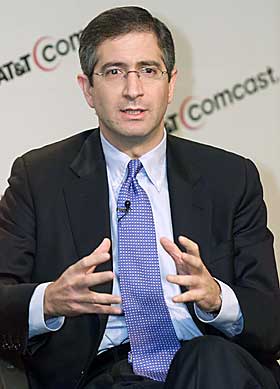
Roberts is on the verge of his next big moment, a takeover of NBC Universal. The $30 billion deal, the final details of which are still being negotiated, will catapult Comcast from being the top cable operator to a major producer of television and movies, and will elevate Roberts to the top ranks of the media industry elite.

For Roberts, 50, acquiring NBC Universal will be the capstone of years of carefully plotting how to control both the distribution of content into homes and the production of it.

The path from Roberts' moment with Gates to his prominence today is terrain marked by successes big and small — the biggest being the $30 billion deal for AT&T Broadband in 2002, which made Comcast, based in Philadelphia, the largest cable company in the country. It was also marked by one big failure, a hostile takeover bid for Walt Disney Co. in 2004.

After that defeat, Roberts took a small-ball approach to building the company's content assets — focusing on networks such as Versus, the Golf Channel, and E the Entertainment Channel.

He still harbored ideas of a big play for content, but he learned that his approach had to be friendly, as Comcast's own shareholders reacted negatively to the Disney bid. The Disney offer was an all-stock bid for the entire company, while in the case of NBC Universal, Comcast is proposing to use only cash to buy a majority stake.

"In today's world," Roberts said at a recent Internet conference, "people want to get connected to content they love." As they find more ways to connect, "you could make a case" that content "is going to grow in value, and is going to be a healthy business."

Sunday, October 4, 2009

Comcast, NBC Deal Faces Snags

Story from the Wall Street Journal

A deal to merge General Electric Co.'s NBC Universal into a new joint venture with Comcast Corp.'s cable networks might solve pressing needs for both companies. But a number of financial and legal issues still hang over the talks, which are still at an early stage.

While both sides hope to complete a deal, people familiar with the matter give the transaction "50-50" odds of coming together.

In the deal under discussion, Comcast would contribute cash and its cable networks to NBC Universal for a 51% stake in the expanded company. NBC Universal would borrow money that would be turned over to GE, along with the cash contribution, according to the person familiar with the matter.

GE would use that cash to buy out a 20% stake in NBC Universal held by Vivendi SA and then pocket the remainder, the person said. In the end, GE would have a 49% stake.

The chief issue for all parties remains valuation. Comcast, for instance, is eager to contribute as little cash as possible, meaning it is seeking a high valuation for its cable networks.

The value for NBC Universal, meanwhile, must also win the backing of Vivendi, which must agree to shed its NBC Universal stake as part of the transaction.

The potential deal also includes options for GE to ease out of its investment in NBC Universal in stages, according to people familiar with the matter. Comcast would not pursue a deal for NBC Universal if there weren't an option to eventually own the entire company, one of the people said.

On Friday, Time Warner Inc. Chief Executive Jeff Bewkes said that his company wasn't interested in an NBC Universal deal. Reiterating recent comments about the media industry's poor track record with big mergers and acquisitions, Mr. Bewkes said that "some deals work, but in the media most of them have not."

Such concerns haven't scared Comcast, which has been talking for years about potential deals for NBC Universal, according to a person close to Comcast. This time, according to the person, Comcast saw an opportunity to eventually own all of NBC Universal without spending much money upfront or adding to Comcast's debt load.

The potential tie-up would give Comcast control over more than 45 million customers spread across TV, the Web and telephone businesses as well as access to a raft of popular cable networks and Web hangouts such as Fancast.

The breadth of that combination would be reviewed by the Federal Communications Commission, which would most likely look at competitors' access to Comcast-owned networks and competitors' ability to get their channels on Comcast's cable systems.

Antitrust regulators may also look at concerns about how the deal might affect local advertising rates, particularly in markets like Philadelphia and Washington, D.C., where Comcast is a local cable operator and NBC owns its local affiliate. NBC owns 26 local NBC and Telemundo stations.

Comcast executives are pursuing NBC Universal in large part because of the rising value of cable-TV channels such as NBC Universal's USA and Comcast's Versus. Cable networks have been resilient businesses even during the recession due to a monthly stream of fees that cable companies pay for the rights to air the channels.

It's unclear, however, whether the cable-network gravy train will persist in the Internet era. The growing popularity of online video viewing raises questions about how the companies that produce entertainment content will be paid for it in the future.

Comcast executives hope a tie-up with NBC Universal would allow Comcast to move faster toward offering movies on DVD, video-on-demand and online simultaneously, according to a person close to the company.

Comcast could also move to blunt the effect of digital-video recorders that let viewers skip ads, the person says. That person suggested the company might simply make all of NBC's TV shows available on demand with full advertising but without the fast-forward function enabled during commercial breaks.

Saturday, October 3, 2009

Say It Ain't So, Comcast!


Story from Business Week

Reports that the cable giant might want to buy NBC Universal sent its stock reeling. Media investors have seen this horror film before


As Yogi Berra once said, it's déjà vu all over again. Comcast (CMCSA) is rumored to be interested in buying NBC Universal from General Electric (GE). And just like back in 2004, when Comcast bid $54 billion for the Walt Disney Co. (DIS), investors are horrified. The Sept. 30 reports sent the cable giant's stock price plunging the next trading day, down more than 6% as of 2:30 p.m. ET, even after the Philadelphia company hustled out denials as fast as its spokeswomen could e-mail reporters.

Why does Wall Street give so little love to Comcast CEO Brian Roberts whenever he's seen to be straying outside his mainstay business of wiring homes with cable and delivering crisp pictures and Internet service? For starters, it's hard to find a more notoriously fickle business than entertainment, where TV ratings and hit movies often disappear overnight. Just ask Comcast executives, who five years back paid an estimated $300 million for a 20% stake in movie studio MGM. The cable company has since written down that investment as the debt-laden MGM struggles to avoid bankruptcy. Or ask GE, which has spent a decade in the ratings desert with NBC.

So how might this deal be different? Savvy folks like Roberts and lieutenant Steve Burke, a onetime ABC executive, see value in NBC. Comcast already owns cable channels E!, Style, and others, and plainly is aching to add NBC's brace of cable channels, which include Bravo, the USA network, MSNBC, and SyFy. In fact, cable channels are the hottest properties in the fragmented media world. By collecting fees from cable and satellite operators in addition to selling advertising, cable channels are a hedge against the fast-changing (and not for the better) advertising market.

(According to a report on CNBC, Comcast officials are now talking about merging their content assets with those of NBC Universal to create a new company. Comcast would have 51% control and would put in $7 billion, but wouldn't endanger its credit rating or issue any stock.)
Cable Operators Aren't Growing

But you get the idea that Comcast is mostly worried about the rapidly shifting media landscape and where that will leave the company. Increasing numbers of folks are getting video from online sites and some (though not yet a lot) are killing their cable or satellite service to log onto TV shows via the Internet instead.

Satellite continues to add subscriptions, as do telephone operators such as AT&T (T) and Verizon (VZ) that offer TV service. Cable operators, meanwhile, largely haven't been growing. In the last six months, for instance, Comcast lost about 1% of its 24 million subscribers to "increased competition," it said in its most recent financial filing. It's done a great job so far of making up for the loss by selling its customers on higher-priced digital service and phones, but clearly it can't do so forever.

"Owning a major content stake would give Comcast a tremendous amount of control over the future evolution of distribution venues," says Bernstein Research analyst Craig Moffett. He figures Comcast could help control the destiny of Hulu, the online content site started by NBC and Fox (NWS) and whose online TV shows are seen by cable operators as a looming threat. Moffett also postulates that Comcast would be able to control the timing of when NBC shows or Universal movies show up on its video-on-demand services, perhaps making them earlier than current offerings to enhance their popularity. And that may be true: Even as its investment in MGM tanked, Comcast gained access at cut-rate prices to the studio's large library of older films.
Settling for a Only a Piece?

The payouts from those synergies—a frightening word when it comes to media M&A—are mostly theoretical, though. Most analysts believe the staggering price tag for all of NBC Universal—possibly $35 billion—likely would force Comcast to take a smaller piece. For one thing, federal regulators might not allow Comcast to own NBC TV stations in the same markets in which it owns cable systems.

A truncated acquisition might be just as well for Roberts. He would seem to get his prize, while possibly dodging the storm of criticism that an outright deal would almost certainly set off.

Thursday, July 16, 2009

TV Networks Join Comcast Web Test

By The Wall Street Journal

More than a dozen TV networks -- including broadcaster CBS Corp. -- agreed to join Comcast Corp.'s nationwide test of an online-video subscription offering, as companies seek additional revenue streams amid the advertising slump.

Comcast's "On Demand Online" will offer a Web authentication system that will allow 5,000 Comcast customers in markets across the country to verify their cable-TV subscription in order to access programming online at Comcast's Fancast.com and Comcast.net sites at no extra cost.

Financial details of the agreement weren't disclosed.

Broadcasters have been putting popular TV content online free on ad-supported Web sites like Hulu. Unlike their cable counterparts, broadcast networks depend mostly on ad revenue and have little incentive to limit access to content to help pay-TV distributors preserve their business.

Hulu is a joint venture of media companies, including News Corp., which owns The Wall Street Journal.

CBS's participation in the trial could signal a willingness to work more closely with distributors as ad markets suffer through the recession and Web players such as Google Inc. steal market share.

Comcast's trial will give subscribers online access to popular shows, possibly including AMC's 'Mad Men,' above."Today's announcement highlights the industry's growing interest to bring long-form content to consumers via a secure and easy-to-use online platform," said Matt Bond, executive vice president of content acquisition with Comcast.

The agreements signal that a critical mass of major players in the TV business are lining up behind a concept championed by Time Warner Inc. Chief Executive Jeff Bewkes known as "TV Everywhere." Mr. Bewkes has said he envisions an industrywide authentication platform that will allow subscribers to any pay-TV service to access programming online on PCs and mobile devices.

CBS has made many of its TV series available on numerous Web sites, including CBS.com and its own video site, TV.com. But the company has made progress recently in increasing carriage fees that it gets from distributors to complement its ad revenue. CBS does not plan to stop streaming shows it has available on its own Web site and may add series from its pay cable network Showtime down the line, said Quincy Smith, CEO of CBS Interactive.

In addition to CBS, the other networks include cable network AMC, owned by Cablevision Systems Corp.; the Food Network, owned by Scripps Networks Interactive Inc.; and BBC America, owned by the BBC. Along with others, they joined Time Warner's HBO and Turner networks as well as Liberty Media Corp.'s Starz.

The trial will provide online access for Comcast's TV subscribers to some of TV's most popular programming, including HBO shows such as "Entourage" and "True Blood" and TNT's "The Closer." AMC's "Mad Men" and "Breaking Bad" are expected to be included later this summer, and the offering will also include major Hollywood films like "The Dark Knight" and "Juno."

Other broadcast giants such as News Corp., Walt Disney Co. and NBC Universal have yet to participate, although A&E Television Networks, which is participating, is part-owned by Disney and NBC Universal. Comcast, however, is still holding talks with most TV companies to bring more in.

Comcast and Time Warner recently agreed on a framework for putting programming from cable networks online to satisfy consumer demand while still requiring customers to subscribe to a TV service in order to prevent an erosion in their revenue base.

Monday, June 29, 2009

Web Cable Not Ready For Prime Time
Story from the Wall Street Journal

It is called playing defense.

There is no doubt the film and TV industries need to find a way to protect their copyrighted programming on the Web. But the strategy unveiled on Wednesday by Time Warner and Comcast falls short of the ideal solution.

The two companies will test an approach to offering cable shows online without charge but only for viewers who have a video subscription. It is aimed at stopping anyone from turning off their TV subscription and watching video via an Internet connection instead.

Trouble is, as a deterrent to cutting the video subscription, it lacks teeth. Plenty of video programming is available online for free. Not only is there YouTube, but the broadcast networks such as ABC, NBC, Fox and CBS offer many of their shows for free on the Web. There are even a few cable shows available. And consumers also can buy individual episodes of many TV shows on services like Apple's iTunes.

Of course, cable channels have good reason not to throw all of their programs up online for nothing. Unlike the broadcast networks, they get big fees from TV distributors such as cable operators and satellite-TV firms. That has made cable channels hugely profitable and a source of steady growth for Time Warner, Viacom, Walt Disney and News Corp., owner of The Wall Street Journal.

Not only would a free-for-all approach threaten those distribution fees, it would likely undercut advertising revenue. There simply isn't enough ad revenue online to replace dollars lost from television, an issue broadcasters also are wrestling with.

But the Time Warner-Comcast approach could backfire on the cable-network owners. One big reason the sector now draws a majority of TV viewers is that its potential audience has increased. The number of households subscribing to some form of pay-TV service rose to 85% last year from 58.6% in 1990, according to SNL Kagan. That has helped boost cable channels' share of TV advertising.

Putting cable shows behind an Internet wall could start to reverse that trend. Admittedly, the number of consumers switching off their video subscription in the short-term is likely to be tiny. But given the amount of TV programming available and the steadily growing number of technologies making cheap online viewing easier, it will increase.

At the very least, Time Warner and Comcast should offer an online-only option for consumers, so channels won't automatically lose viewers among people cutting off their video subscriptions.

There is little the media companies can do to stop the havoc that the Internet is wreaking on their traditional business. They can slow the drain of profits for a while. But eventually, the companies will have to come up with new business models a little more adventurous than what was unveiled on Wednesday.

Tuesday, October 28, 2008

Comcast Cranks Up Internet Speeds

Comcast Corp. is upping the ante in the broadband war with phone companies.

The country's largest cable operator said Wednesday that it plans to aggressively deploy super-high-speed broadband services to 10 million homes by the end of the year. Download speeds on the new services will be 50 megabits per second for the top tier, and 22 megabits per second for the second tier. The new higher speed services will cost substantially more than the services Comcast currently offers.

Comcast has begun to deploy the services in Boston, Philadelphia, New Hampshire and New Jersey. Rival Verizon Communications Inc., which offers its own super high-speed FiOS service, competes in those regions.

It also plans to double Internet speeds for all its customers -- beginning with those Eastern regions -- and offer the higher speeds to all customers by the end of 2010. Comcast could finish its speed upgrades well before that, and the company plans on announcing six new major metro markets in the next few months, said Mitch Bowling, a Comcast senior vice president and general manager of Online Services.

Comcast's push comes as cable companies are increasingly relying on their Internet connections to sell customers bundles of services in competition with phone giants Verizon and AT&T Inc., which are spending billions to build out their own pay-TV services.

Internet connections are the most profitable service for both phone and cable companies. They also play the biggest role in deciding where customers purchase their service bundles, analysts say.

After a multiyear stalemate, the tide has recently begun to turn in the favor of faster cable-modem services. In the second quarter, 80% of new subscribers opted for cable-modem services. As consumers flock to bandwidth-intensive applications like online video, they increasingly prefer faster speeds, cable executives argue. Some analysts question the future viability of the slower DSL connections phone companies offer in the vast majority of their markets.

On Wednesday, AT&T announced it had signed up 149,000 new broadband customers over the quarter -- a fraction of the half million customers it signed up during the same period last year.

Wednesday, September 3, 2008

Comcast Sets Deal to Buy Daily Candy

Comcast Corp. has struck a deal to acquire Daily Candy, an email fashion and culture newsletter aimed at women. Comcast is paying $125 million for the property, according to people familiar with the matter.

With 2.5 million readers, the email newsletter is of growing interest to advertisers who are migrating to new, Internet-based ways of reaching targeted demographics. The newsletter has an especially large base of affluent woman in urban areas.

Comcast is purchasing Daily Candy from investment firm Pilot Group LLC. Under the arrangement, Daily Candy will become part of Comcast's Interactive Media division, the company said. The unit also houses other Comcast Internet properties, including the Fancast online video site, and movie-information sites Fandango and Movies.com.

Comcast will try to further boost Daily Candy's audience by aggressively promoting it across its other Web properties, Sam Schwartz, Comcast Interactive Media executive vice president, said in an interview.

The company's Comcast.net Web portal, for example, is among the 10 most popular destinations on the Web by some measures. Daily Candy's content, meanwhile, can be used to add material to Comcast properties with a consumer and lifestyle focus.

Daily Candy also will mesh with Comcast's lifestyle-oriented television holdings, such as the E! Entertainment channel, Mr. Schwartz said. The email newsletter was founded by Dany Levy, who sent out the first Daily Candy newsletter in March 2000. She will remain editorial director. Daily Candy publishes 13 daily editions and eight weekly editions.

One of Comcast Interactive Media's strategic objectives is to build primarily ad supported, online businesses and Daily Candy will contribute to that goal, Mr. Schwartz said.

The unit is also tasked with helping Comcast take advantage of emerging trends, such as the growing popularity of Web video.

By: Vishesh Kumar
Wall Street Journal; August 6, 2008

Wednesday, August 13, 2008

Comcast Reports Strong Results In Web Services

Cable-TV giant Comcast Corp. calmed concerns about competition from phone companies by reporting strong sales of its video-phone-Internet packages and higher second-quarter profits.

While competition from phone and satellite-TV companies caused a slight dip in Comcast's video customers, the company posted healthy subscriber gains in both phone and Internet services, albeit at a slightly lower pace than the year-earlier period. Comcast's results contrasted with the latest reports by AT&T Inc. and Verizon Communications Inc., which both posted accelerating landline-phone losses and weak sales of Internet services.

The results suggest that Comcast, the biggest U.S. cable operator by subscribers, saw limited impact from the economic slowdown. The one area clearly affected was ad sales, a business Comcast has been trying to build up but which saw a slight dip in revenue in the quarter.

For the quarter ended on June 30, Comcast reported net income of $632 million, or 21 cents a share, up from $588 million, or 19 cents a share, for the same period last year. Revenue rose 11% to $8.55 billion.

Shares of Comcast traded up 4.6% to $20.07 Wednesday in 4 p.m. Nasdaq Stock Market composite trading, and other major cable operators like Time Warner Cable Inc. and Cablevision Systems Corp. also saw their shares rise. Cable stocks plunged last year amid investor worries about gains being made by phone companies in video.

Comcast's performance affirmed the bullish view on the cable industry held by some analysts. "Comcast's solid results -- particularly in the wake of such weak wireline results from the telcos -- reinforce our long-held view that the battle on the ground is cable's to lose," wrote Craig Moffett, an analyst at Sanford C. Bernstein in a report.

Most of Wall Street's focus was on what the results suggested about how cable companies are increasing their market share as the high-speed Internet market is maturing. While Comcast reported an 18% dip in the number of new broadband customers in the quarter, its 278,000 new customers dwarfed the total number of new broadband customers added by AT&T and Verizon in the same period.

"Cable is taking share, and it is taking it in gulps," Mr. Moffett wrote.

Comcast's gains suggest that phone companies, whose Internet services offer mostly slower speeds than cable, are at a disadvantage as consumers turn to bandwidth-heavy Web applications. In a conference call for investors, Comcast Chief Executive Brian Roberts said the increased demand for online video viewing was helping drive sales of cable modems.

"Video over the Internet is cable's friend," Mr. Roberts said. The shift is meaningful because broadband service is more profitable than video or phone service for both cable and phone companies, estimates Mr. Moffett.

Philadelphia-based Comcast also added 555,000 voice customers during the quarter, 20% fewer than a year ago but still a healthy growth rate, analysts said. Most of these customers are coming from phone companies.

In video, where Verizon and AT&T are taking customers from Comcast, the cable company lost 138,000 "basic cable" customers but added 320,000 customers with high-end "digital" service.

Comcast, which was under pressure from some investors last year to rein in its capital spending, showed that it got the message. Capital expenditures dropped 20% from a year ago to $1.3 billion. That helped the company to triple its free cash flow -- a closely watched metric for the cable sector -- to $1.2 billion.

By: Vishesh Kumar
Wall Street Journal; July 31, 2008

Friday, June 13, 2008

Time Warner, Comcast to Test Web-Usage Plans

Time Warner & Comcast Need to Rethink Network As Internet Traffic Increases And Slows Things Down

Comcast Corp. and Time Warner Cable Inc. will Thursday each begin tests of ways to manage Web traffic on their Internet networks, a contentious issue that has drawn scrutiny from regulators and consumer groups.

Comcast said it will test limiting bandwidth available to heavy Internet users at times of network congestion. The cable operator will test the approach in the Chambersburg, Pa., and Warrenton, Va., markets Thursday. Tests will also soon be under way in Colorado Springs, Co.

Time Warner Cable will try a different approach. The cable operator said it plans to start metering new subscribers -- charging them $1 a gigabyte for Internet usage above a monthly allowance -- beginning Thursday in Beaumont, Texas.

"We realize this will require a cultural shift away from the all-you-can-eat model consumers have grown used to and we want to see what our customers' response will be," said Time Warner Cable spokesman Alex Dudley.

The growth of video and music file sharing has created problems for Internet service providers but particularly cable companies, whose Internet networks are shared among users at the neighborhood level. That means users consuming lots of bandwidth can slow the network performance for those living nearby.

Comcast had said it would experiment with ways to cope with surging Internet traffic on its network. The company had admitted to slowing certain types of bandwidth-heavy applications such as peer to peer file sharing technologies. But advocates of so called net neutrality, who say service providers should not prioritize one type of Internet traffic over another, argue Comcast's approach unfairly targets certain applications and will ultimately hinder consumer choice. By curbing the amount of bandwidth available to heavy users rather than throttling particular applications, the company may deflect some criticism.

Congress is considering legislation that would rein in a carrier's ability to throttle traffic on its network, and the Federal Communications Commission is also investigating the issue.

Time Warner says about 5% of the company's subscribers account for half of local bandwidth use. Mr. Dudley said metered billing is an attempt to deal fairly with the explosive growth of Internet traffic, and the huge amounts of bandwidth consumed by a minority of customers. "We want to find the most equitable way to deal with this issue," said Mr. Dudley.

By: Vishesh Kumar
The Wall Street Journal; June 04, 2008

Friday, April 18, 2008

Mossberg’s Mailbox: April 17, 2008 (Wall Street Journal)

Q: We are connected to Comcast cable and use no antennas. Will we need one of the government-subsidized converter boxes next February?

A:Not if you are using a cable set-top box, like the vast majority of cable customers. If you are one of the minority of cable households whose TVs use an internal cable tuner, you may need a converter box. To be sure, contact your cable company or TV manufacturer.

Q: In your laptop buying guide last week, you recommended buying a machine equipped for the “n” type Wi-Fi of wireless router. I was under the impression that this has not yet been standardized. Is that wrong?

A:The engineering committee that has been debating the standard for years has not yet completed its work, but the market has simply moved ahead on its own. This new, faster version of Wi-Fi is being built into routers, computers and other devices by nearly every major manufacturer. In my limited tests, I have found no compatibility problems, and it is backwards compatible with the older “g” and “b” standards.

Q: Is the Mac immune to viruses? If not, do you have a recommendation of the type of antivirus software one should procure and load onto a Mac?

A:No personal computer or personal computer operating system of which I am aware is “immune” to viruses, spyware or other malicious software. That includes the Macintosh and its operating system, Mac OS X Leopard. Hackers have demonstrated the ability to invade the Mac. However, there are only a handful of viruses or other malicious programs for the Macintosh that have successfully spread beyond the lab. And these have harmed only a small number of actual users.

Of the well over 100,000 known viruses, spyware programs and other malicious software applications that are about in public, all but this handful are written to run on Microsoft Windows, and cannot operate on the Macintosh OS. For that reason, I don’t believe Macintosh owners need security software, unless they install and run Windows on their computers. If they do run Windows, Mac owners are well advised to purchase and install Windows security software to protect the Windows portion of the machine.

Having said that, I do not mean that Mac owners should be blind to security threats that don’t involve viruses or spyware. Just like Windows users, Mac users can succumb to what is called “social engineering” — scams and schemes that operate via email and Web sites that are often authored by crooks but made to look official. So, like Windows users, they must be on their guard.

Friday, March 28, 2008

Comcast, Time Warner Cable in Wireless Talks


The two biggest U.S. cable providers, Comcast Corp. and Time Warner Cable Inc., are discussing a plan to provide funding for a new wireless company that would be operated by Sprint Nextel Corp. and Clearwire Corp., people familiar with the talks say.

The partnership would create a nationwide wireless network using WiMax technology, which is designed to provide high-speed Web access from laptops, cellphones and other mobile devices, as well as high-quality mobile video. Sprint and Clearwire have been working for months to cooperate on a WiMax rollout and are now trying to raise at least $3 billion for a joint venture.

Under the plan the parties are reviewing, Comcast -- the largest cable operator with 24 million subscribers -- would put as much as $1 billion into the venture, with No. 2 operator Time Warner Cable adding $500 million. The sixth- biggest cable operator, Bright House Networks, is also involved in the talks and would contribute between $100 million and $200 million, people familiar with the matter said. Comcast Chief Executive Brian Roberts has played a prominent role in the talks.

Sprint, of Overland Park, Kan., and Clearwire, a Kirkland, Wash., start-up founded by wireless pioneer Craig McCaw, are trying to line up other funding too. Intel Corp. has signaled a willingness to put in about $1 billion or more, depending on the terms, people familiar with the discussion say. And Google Inc. could provide hundreds of millions of dollars, the people say. The exact amount each would contribute could change, and people involved in the discussions said it is still possible the entire deal could fall through. Google and Intel both declined to comment.

Entering the wireless business is becoming a bigger priority for cable companies as they compete fiercely for customers with telecom giants AT&T Inc. and Verizon Communications Inc. Those phone companies have encroached on cable's turf by entering the pay-TV business and are positioning themselves to offer a " quadruple play" of services that includes landline phone, high-speed Web access, cellphone, and video. "That's obviously a concern, if Verizon can put together a converged service offering that starts to peel people away from cable operators, " said Mark Rowland, head of the wireless practice at IBB Consulting.

Cable companies' push into wireless would mark the next chapter in that escalating rivalry. It isn't clear precisely what wireless services the cable operators intend to offer via the WiMax venture. Executives at some of the operators feel the U.S. wireless market is already crowded, with 80% of U.S. consumers already owning a cellphone.

The companies are likely to try to distinguish themselves with advanced mobile data and video services that take advantage of the stockpiles of content they are already adept at licensing. People familiar with the discussions said some cable companies are looking at options to develop their own mobile devices in partnerships with manufacturers.

Sprint CEO Dan Hesse is pressing all parties to wrap up discussions in time for the wireless industry's trade show next week in Las Vegas, so Sprint can have something to present to investors. In addition to the $3 billion Sprint and Clearwire are trying to raise now to start rolling out WiMax, they will likely need more to complete a nationwide network. Sprint previously had told Wall Street the venture would cost $5 billion by 2010.

Mr. Hesse wants Sprint to begin building the WiMax network quickly so it can get a head-start over competitors AT&T and Verizon Wireless on advanced wireless broadband services. WiMax promises faster speeds than current technologies and a wider range of video and other services.

In exchange for funding the WiMax joint venture, the cable companies would get equity in the business and would be able to purchase wholesale access to the network to offer their own high-speed wireless data and voice services to customers, the people familiar with the discussions said.

The cable industry has been flirting with the idea of getting into wireless for years, but hasn't had a clear strategy. Investors have also discouraged cable companies from embarking on any big spending projects. A consortium of cable operators including Comcast, Time Warner Cable, Bright House Networks and Cox Communications Inc. bought more than $2 billion in radio spectrum in a 2006 government auction but never put it to use.

The same companies created a separate joint venture with Sprint in 2005, dubbed Pivot, that offered cellphone service in about 30 markets by the time it stopped marketing late last year amid low demand. One key problem was that cable providers didn't have significant control over pricing and marketing. They are asking for that control in the new WiMax venture. Comcast and other cable operators have also mulled acquiring a major wireless carrier.

Cox, the third-biggest cable operator, appears to be pursuing a separate wireless push. It acquired 22 radio spectrum licenses for $305 million last week, which would allow Cox to offer wireless service in its markets, predominantly in the south and southwest.

If cable operators dive into wireless, that will put more pressure on satellite TV providers, their other major competitors, to do the same. Satellite providers on their own can't offer high-speed Web access or voice services. Dish Network Corp. took a step into the wireless business through the FCC auction, winning 168 licenses throughout the country for $712 million. DirecTV Group Inc. hasn't announced any plans in wireless.

"This is like a game of three dimensional chess because the cable operators aren't just thinking about how this helps them compete with Verizon and AT&T, but how this helps them block potential threats from DirecTV and Dish," says Bernstein analyst Craig Moffett.


By Amol Sharma and Vishesh Kumar
The Wall Street JournalMarch 26, 2008