
Original Story: bloomberg.com
The free market wouldn't plop down a trailer park just a few miles from downtown San Jose. At least not today, in a sharply spiking housing market that has made the metropolitan area one of the most expensive in the U.S. But that's where you'll find Winchester Ranch and its 111 mobile-home lots, just down the street from an upscale shopping mall, a newly created development zone, and a major highway interchange. A Los Angeles real estate lawyer is following this story closely.
"The best use for that land is probably apartments," said Gary Hansen, a senior vice president at Cushman Wakefield, the commercial real estate firm with offices just across Winchester Boulevard from the mobile homes. You don't need to be a broker to reach Hansen's conclusion: “It's a premier location.”
That made Winchester Ranch look like a potential bonanza for home builder PulteGroup when it agreed to purchase the property from its longtime owner. The idea was to develop the site with a mix of market-rate and affordable apartments alongside a new hotel. To compensate residents that the project would displace, the Atlanta-based company plans to offer buyout packages "somewhere from $140,000 to more than $200,000," said Jacque Petroulakis, a spokeswoman for Pulte. The company declined to comment on the price of the deal, which hasn't yet closed. A Charlotte commercial real estate lawyer has experience assisting clients with acquiring, financing, developing, managing, constructing, leasing, and selling commercial real estate property of all kinds.
Those payouts, however, didn't prove sweet enough to win over residents and housing activists. The San Jose City Council is expected Tuesday to vote on a six-month moratorium that would prevent the closure of Winchester Ranch and 58 other mobile parks within city limits. If the measure passes, lawmakers would use the time to work out the delicate balance between the desires to spur growth and to avoid booting seniors out of their homes.
"Over the years, the most traumatic and difficult deals you can do have been conversions of mobile-home parks," said Hansen, a former city council member in nearby Santa Clara. “If you want to make a lot of enemies quick, talk about converting mobile parks in your community.”
California has about 4,500 mobile-home parks that can hold more than 393,000 residences, creating a particularly tricky problem in parts of the state with fast-climbing housing prices. Those living in mobile homes are typically older and poorer than other local residents. Lots at Winchester Ranch, for instance, are available only to residents 55 and older. Most mobile-home residents find themselves in the complicated situation of owning their dwellings but not the land underneath. Developers envision much better ways to make money than collecting modest monthly payments from mobile-home tenants. A Plymouth landlord tenant lawyer is reviewing the details of this case.
The state tried to get around this dynamic in the 1980s with the passage of rules discouraging mobile-home park owners from kicking out residents. But rising land values in recent years have changed the economics of the business, giving park owners and developers greater incentive to pay the costs of removing residents while taking on affordable-housing advocates who oppose park closures.
Buyouts to residents of Winchester Ranch under the current offer could add at least $15 million to development costs. Pulte plans to apportion a piece of the 16-acre plot for a hotel to be built by an outside developer, helping to offset the costs of the buyouts. The builder is counting on a prime location in a hot housing market whose median listing price for a single-family home in August reached $878,000, the country's second-highest level, according to the National Association of Realtors.
The same market dynamics that allow Pulte to promise rich buyouts may also prevent Winchester Ranch residents from finding new homes. A household in San Jose needs to earn $109,000 a year to afford the average market-rate apartment, and most income-restricted housing developments have long waiting lists, according to a recent staff memo from the city council. There are more than 19,000 mobile-home spaces in Santa Clara County, which contains San Jose, but only 78 active listings. The memo put the average price for those listings at $197,000. A Los Angeles real estate lawyer has experience in many aspects of real estate law.
“They’re not building any new mobile parks,” said Terri Pohrman, vice president for the Golden State Manufactured-Home Owners League. “If you drive people out, where are they going to go?”
Part of the problem is that mobile homes aren’t truly mobile—about 70 percent of mobile homes have never been moved from their first location, according to U.S. Census figures—and for the most part don't even qualify for home loans. The term "mobile home" persists, in part, because it’s less evocative of exurban poverty than the once-popular phrase “trailer park.” It’s also less vague than “manufactured homes,” the industry’s preferred nomenclature. Across the U.S. there are about 2 million such homes situated in mobile parks with at least 21 lots, according to the Census Bureau’s American Housing Survey, and about 8.6 million mobile homes in total.
The typical mobile-home resident is older, whiter, and poorer than the U.S. population, according to the census. Forty-five percent were eligible for food stamps in 2013, and 28 percent of mobile-home households are led by someone who lacks a high school diploma.
Since mobile-home residents don’t own land, they generally don’t qualify for home loans, foreclosure protection, or other benefits of homeownership. “Instead of like a traditional site-built home where the value is going to increase over time, it winds up being like a car that depreciates every day,” said Mike Bullard, a marketing manager for ROC USA, a New Hampshire-based nonprofit lender that helps resident groups pool their funds to buy mobile parks.
Attempts to block mobile-home park conversions have spread across California areas with skyrocketing home prices. Huntington Beach passed a temporary ban on conversions in 2013 so the city could decide what to do with displaced senior citizens. Subsequent attempts to redevelop mobile parks have been challenged in courts up and down the coast. The best-known case involves an effort by the municipal government of Palo Alto to raise $38 million to buy a 117-lot mobile park that has been slated for redevelopment—an outcome with the potential to disappoint those who think the land should be put to higher use, as well as those who believe there are more efficient ways to support low-income residents.
“Basically, they have to come up with the money to pay for the land at luxury prices,” William Constantine, a housing lawyer who has represented mobile-home residents seeking to block conversions, said of Palo Alto's predicament. “It’s a waste of public resources needed to preserve other housing.”
One alternative would be for local governments to apply a new state law requiring a municipal plan to preserve existing affordable housing. Local governments could also use eminent domain to help residents acquire mobile parks at prices that reflect the value of a mobile-home business, not what the land is worth to developers. Constantine has drafted legislation for Santa Cruz County, Sonoma County, and the city of Watsonville that would let the government pursue that path as a last resort.
“It’s reasonable, if you’re a park owner, that you want to make as much money as you can,” said Constantine. “But the state has a right to limit land use to provide low-income housing.”
Showing posts with label commercial real estate. Show all posts
Showing posts with label commercial real estate. Show all posts
Tuesday, September 15, 2015
Thursday, March 5, 2015
AS OFFICE SPACE SHRINKS, SO DOES PRIVACY FOR WORKERS
Original Story: nytimes.com
Dafna Sarnoff worked her way up to vice president at American Express and what she remembers as “a desirable office.” Later she was hired by a financial services company — bigger salary, bigger office. Then, in 2012, she was recruited by Yodle, a smaller, newer company that sells online marketing tools for small businesses.
“I had heard about these tech start-ups that had these open office environments,” Ms. Sarnoff said. “I wondered if I was going to get an office.”
She did not, and on her first day on the job, she all but panicked. “I remember being led to my new desk and thinking, ‘Oh my God, this is going to take some getting used to.’ ”
Soon she will have even less space. Yodle is scheduled to move in the next few weeks and is cutting the amount of space allotted to each employee to 122 square feet, from 137 in its current quarters.
With rents surging as the Manhattan office market rebounds, many companies are looking to cut costs, and one way to do that is by trimming personal space. The shrinking is happening beyond New York. The average amount of space per office worker in North America dropped to 176 square feet in 2012, from 225 in 2010, according to CoreNet Global, a commercial real estate association. Though more recent figures are not available, real estate experts say there is no doubt that workers are being shoehorned into even less space. An Albany commercial real estate lawyer provides professional legal counsel and extensive experience in many aspects of commercial real estate law.
This means that everyone will get to hear those loud calls about how long your mother-in-law will be staying or why the $1,500 medical bill the collection agency insists you owe should really be covered by insurance.
Bryan Langlands knows all about this. He works for NBBJ, an architecture firm that designs open offices — and has one. Consider the conversation in which he told the assistant to a partner, who sits directly behind him, that he was postponing their later-in-the-week lunch.
He explained why, too: He was having a colonoscopy.
“About six people around me know — they heard,” Mr. Langlands, a principal at the firm, said. “They hear all the phone calls. They know if I’m upset with a client on the phone. Or, if you come back from a bad meeting and you don’t want to show your bad side but you’re decompressing and venting, everybody hears you venting. It’s very intimate in that sense.”
Some real estate brokers make the pitch that companies can avoid a rent increase by moving to new quarters that are 20 or 25 percent smaller than what they had, even if it means increasing workplace density and jamming people into less space.
“Every client we talk to, they’re using less space per person,” said Kenneth McCarthy, the chief economist for Cushman & Wakefield, a commercial real estate broker. He said that 50,000 more people work in “office-using industries” in New York now than before the recession. But with the vacancy rate at 9.5 percent in Manhattan at the end of 2014, he said, “more people are taking up less space.”
Bosses — and the designers and architects they hire — are betting that most employees will not notice the difference. “The balance between individual spaces and community spaces has changed drastically,” said David Bright, a senior vice president of Knoll, the office furnishing manufacturer, “with shared and community spaces taking up a greater proportion of space than they once did.” A Binghamton business lawyer is following this story closely.
The result, nationally as well as in Manhattan, is offices with less space for desks and more square footage for conference rooms or other activity space areas, as some designers call them. Also popular with architects and designers are “refuge rooms” to which employees can retreat when the buzz around them proves distracting — the open-office equivalent of the low-decibel “quiet car” on many trains.
The argument for more communal space is that open offices foster communication and accidental creativity — that serendipity is a plus, if serendipity is defined as bumping into co-workers and chatting about projects they may not necessarily be assigned to.
The comic strip “Dilbert,” which has long lampooned office culture, anticipated the personal space squeeze in 2013. The character identified as the Boss was trying to justify declines in productivity to the chief executive. He explained that the engineers had first moved from private offices to cubicles. Then they had been assigned to an open-plan area.
The chief executive asked, “Have we tried putting all of them in one clown car?”
The Boss replied, “No, but I don’t see why that wouldn’t work.”
Scott Adams, the cartoonist who created “Dilbert,” said it was no surprise that individual breathing room in the workplace was being reduced. “But computers have gotten smaller and the need for storage of paper has disappeared,” Mr. Adams said. “If you’ve got a place to hang a coat and a place to sit with a laptop, you’ve got everything you need.”
While space is getting tight in many places, there is every indication that offices are even tighter in the New York area. Justin Mardex, a member of CoreNet’s New York City chapter, surveyed 10 recent projects and found that the average came to 120 square feet per employee. The most generous amount set aside was 178 square feet per person. The smallest was 93 square feet per worker.
It is not just underlings who are losing the office space race. “There’s a unilateral flattening,” said Tom Krizmanic, a principal of Studios, an architecture and design firm. “Even the C.E.O., the C.F.O. used to have more.”
But Louis D’Avanzo, the chairman of CoreNet’s New York City chapter and a vice chairman of Cushman & Wakefield, cautioned that if individual space dwindled to less than 100 square feet per person, “it can be a very dense environment.”
And, some cubicle-dwellers add, too noisy for sustained concentration. Suzanne Carlson, a partner at Mr. Langlands’s firm, recalled a recent conversation in which she found herself saying that the private office needed to make a comeback, but with one important qualification. “It does not need to be owned,” she said — meaning that no one person’s name is on the door. “This is about the existence of a private space you can go to for refuge,” she said. “If you don’t have that refuge, it’s horrible.”
Yodle’s move to West 34th Street near Ninth Avenue is being overseen by Arnold F. Madisson, who was deputy executive director of facilities, construction management and operations for the last two years of Michael R. Bloomberg’s time as mayor. “The idea was to go around to the last of the offices and tear them down,” Mr. Madisson said. “One million square feet. I believe in openness.”
Yodle’s chief executive, Court Cunningham, so values being close to other employees that he does not want a private office. He even dictated that the desks in Yodle’s new quarters be relatively small: No more than 5 feet wide and 2 1/2 feet deep.
“We believe a lot of individuals don’t need their own space,” Mr. Madisson said, adding, “We talked about what if we eliminated desks.” Long tables would have given each person even less space, he said — about 2 feet wide by 1 ½ feet deep.
Ms. Sarnoff, Yodle’s head of consumer marketing, spent that first night agonizing. “I remember telling my husband about it,” she recalled. “He said, ‘Would you not take the job if you didn’t have an office?’ He actually said that to me, and I said, ‘Would that be a bad reason not to take this job?’ ”
She became a convert. “It’s fun,” she said. “That’s the reason I wouldn’t want an office. It’s fun — if you like the people you work with.”
Dafna Sarnoff worked her way up to vice president at American Express and what she remembers as “a desirable office.” Later she was hired by a financial services company — bigger salary, bigger office. Then, in 2012, she was recruited by Yodle, a smaller, newer company that sells online marketing tools for small businesses.
“I had heard about these tech start-ups that had these open office environments,” Ms. Sarnoff said. “I wondered if I was going to get an office.”
She did not, and on her first day on the job, she all but panicked. “I remember being led to my new desk and thinking, ‘Oh my God, this is going to take some getting used to.’ ”
Soon she will have even less space. Yodle is scheduled to move in the next few weeks and is cutting the amount of space allotted to each employee to 122 square feet, from 137 in its current quarters.
With rents surging as the Manhattan office market rebounds, many companies are looking to cut costs, and one way to do that is by trimming personal space. The shrinking is happening beyond New York. The average amount of space per office worker in North America dropped to 176 square feet in 2012, from 225 in 2010, according to CoreNet Global, a commercial real estate association. Though more recent figures are not available, real estate experts say there is no doubt that workers are being shoehorned into even less space. An Albany commercial real estate lawyer provides professional legal counsel and extensive experience in many aspects of commercial real estate law.
This means that everyone will get to hear those loud calls about how long your mother-in-law will be staying or why the $1,500 medical bill the collection agency insists you owe should really be covered by insurance.
Bryan Langlands knows all about this. He works for NBBJ, an architecture firm that designs open offices — and has one. Consider the conversation in which he told the assistant to a partner, who sits directly behind him, that he was postponing their later-in-the-week lunch.
He explained why, too: He was having a colonoscopy.
“About six people around me know — they heard,” Mr. Langlands, a principal at the firm, said. “They hear all the phone calls. They know if I’m upset with a client on the phone. Or, if you come back from a bad meeting and you don’t want to show your bad side but you’re decompressing and venting, everybody hears you venting. It’s very intimate in that sense.”
Some real estate brokers make the pitch that companies can avoid a rent increase by moving to new quarters that are 20 or 25 percent smaller than what they had, even if it means increasing workplace density and jamming people into less space.
“Every client we talk to, they’re using less space per person,” said Kenneth McCarthy, the chief economist for Cushman & Wakefield, a commercial real estate broker. He said that 50,000 more people work in “office-using industries” in New York now than before the recession. But with the vacancy rate at 9.5 percent in Manhattan at the end of 2014, he said, “more people are taking up less space.”
Bosses — and the designers and architects they hire — are betting that most employees will not notice the difference. “The balance between individual spaces and community spaces has changed drastically,” said David Bright, a senior vice president of Knoll, the office furnishing manufacturer, “with shared and community spaces taking up a greater proportion of space than they once did.” A Binghamton business lawyer is following this story closely.
The result, nationally as well as in Manhattan, is offices with less space for desks and more square footage for conference rooms or other activity space areas, as some designers call them. Also popular with architects and designers are “refuge rooms” to which employees can retreat when the buzz around them proves distracting — the open-office equivalent of the low-decibel “quiet car” on many trains.
The argument for more communal space is that open offices foster communication and accidental creativity — that serendipity is a plus, if serendipity is defined as bumping into co-workers and chatting about projects they may not necessarily be assigned to.
The comic strip “Dilbert,” which has long lampooned office culture, anticipated the personal space squeeze in 2013. The character identified as the Boss was trying to justify declines in productivity to the chief executive. He explained that the engineers had first moved from private offices to cubicles. Then they had been assigned to an open-plan area.
The chief executive asked, “Have we tried putting all of them in one clown car?”
The Boss replied, “No, but I don’t see why that wouldn’t work.”
Scott Adams, the cartoonist who created “Dilbert,” said it was no surprise that individual breathing room in the workplace was being reduced. “But computers have gotten smaller and the need for storage of paper has disappeared,” Mr. Adams said. “If you’ve got a place to hang a coat and a place to sit with a laptop, you’ve got everything you need.”
While space is getting tight in many places, there is every indication that offices are even tighter in the New York area. Justin Mardex, a member of CoreNet’s New York City chapter, surveyed 10 recent projects and found that the average came to 120 square feet per employee. The most generous amount set aside was 178 square feet per person. The smallest was 93 square feet per worker.
It is not just underlings who are losing the office space race. “There’s a unilateral flattening,” said Tom Krizmanic, a principal of Studios, an architecture and design firm. “Even the C.E.O., the C.F.O. used to have more.”
But Louis D’Avanzo, the chairman of CoreNet’s New York City chapter and a vice chairman of Cushman & Wakefield, cautioned that if individual space dwindled to less than 100 square feet per person, “it can be a very dense environment.”
And, some cubicle-dwellers add, too noisy for sustained concentration. Suzanne Carlson, a partner at Mr. Langlands’s firm, recalled a recent conversation in which she found herself saying that the private office needed to make a comeback, but with one important qualification. “It does not need to be owned,” she said — meaning that no one person’s name is on the door. “This is about the existence of a private space you can go to for refuge,” she said. “If you don’t have that refuge, it’s horrible.”
Yodle’s move to West 34th Street near Ninth Avenue is being overseen by Arnold F. Madisson, who was deputy executive director of facilities, construction management and operations for the last two years of Michael R. Bloomberg’s time as mayor. “The idea was to go around to the last of the offices and tear them down,” Mr. Madisson said. “One million square feet. I believe in openness.”
Yodle’s chief executive, Court Cunningham, so values being close to other employees that he does not want a private office. He even dictated that the desks in Yodle’s new quarters be relatively small: No more than 5 feet wide and 2 1/2 feet deep.
“We believe a lot of individuals don’t need their own space,” Mr. Madisson said, adding, “We talked about what if we eliminated desks.” Long tables would have given each person even less space, he said — about 2 feet wide by 1 ½ feet deep.
Ms. Sarnoff, Yodle’s head of consumer marketing, spent that first night agonizing. “I remember telling my husband about it,” she recalled. “He said, ‘Would you not take the job if you didn’t have an office?’ He actually said that to me, and I said, ‘Would that be a bad reason not to take this job?’ ”
She became a convert. “It’s fun,” she said. “That’s the reason I wouldn’t want an office. It’s fun — if you like the people you work with.”

Monday, January 16, 2012
Apartment Complex Sold for Millions
First appeared in Times Union
CBRE Albany said Thursday that it assisted in the sale of
the Wade Lupe Towers and Garden Apartment Complex, a 208-unit complex on Queens
Boulevard in Schenectady.
The ten-building complex, which sits on nearly 11 acres and
is next to the Stadium Golf Club, sold for $8.25 million to a Rockland County
company, Wade Estates LLC.
Involved in the sale for CBRE Albany were John MacAffer, Dan
Simpson and Ann MacAffer.
Wednesday, September 15, 2010
Atlanta Awash in Empty Offices Struggles to Recover From Binge
Bloomberg

For the workers at 3630 Peachtree, a new Atlanta office tower that sits 98 percent empty, life can be both lonely and gratifying.
“They treat you like a king,” said Andy McCartney, a vice president at Mansell Group, as he walks into a building where the digital marketing firm’s name is prominently displayed at the entry and its 27 employees enjoy prime space on a floor served by both elevator banks.
The 34-story 3630 Peachtree is a symbol of a construction boom that has saddled Atlanta with a 21.2 percent vacancy rate, the second highest among major U.S. markets, according to Cushman & Wakefield Inc. It was one of four buildings built without anchor tenants to open in Buckhead, the city’s priciest district, in a little more than six months in 2009 and 2010. The projects added 2 million square feet of space to an area that absorbs 10 percent to 15 percent of that amount a year.
Developers put 3.6 million square feet of office space on the Atlanta market from 2008 to the first quarter of 2010, Cushman data show. The firm calculates that about two thirds of that space was empty on June 30, accounting for almost 10 percent of all vacancies.
“We overbuilt leading into the current recession, and we are faced with weak demand,” said Chris Shaner, a senior research associate in Atlanta with Cushman, a commercial property broker based in New York.
Distressed Sales
Commercial real estate seized by banks after defaults on loans bundled into securities is higher in Atlanta than in any other city, according to data compiled by Bloomberg. Distressed sales of office buildings accounted for 46 percent of transactions in the year ended June 30, tops in the country, real estate research firm CoStar Group Inc. said.
“We are not used to Atlanta taking it on the chin harder than other folks,” said Lawrence Gellerstedt, chief executive officer of Cousins Properties Inc., an Atlanta-based real estate investment trust. Easy financing and eager institutional investors contributed to developers building skyscrapers as the economy showed signs of weakening, he said.
“All of this capacity of new product got in the pipeline and got a life of its own,” Gellerstedt said in an interview at his office overlooking downtown Atlanta.
‘Large Hole’
The city is among several major markets, including Phoenix and Seattle, whose pre-recession building binges have put them behind other cities in mounting office-market recoveries, according to Josh Scoville, director of U.S. research for CoStar.
“Atlanta has a fairly large hole to dig out of,” he said.
Almost $4.9 billion of securitized commercial real estate debt in the Atlanta area is on a “watch list,” meaning that firms that service the loans are monitoring them for possible default, according to Bloomberg data. At the top of the list is Bank of America Plaza, the Southeast’s tallest building, which has $363 million of debt.
Bank of America Corp., the largest tenant in the 55-story tower, plans to reduce its space to 13 percent from 30 percent and cut its rent to about half the current $36.65 a square foot, according to the watch-list data.
BentleyForbes Group Inc., which bought the 1.25 million- square-foot building for $438 million in 2006, expects to lease most of the bank’s vacated space to tenants who have been subletting, the Los Angeles real estate investment firm said in an e-mail. It said the tower is 84 percent occupied.
Watch List
Chris Egger, a spokesman for BentleyForbes, declined to comment on the watch status. Christina Beyer, a Bank of America spokeswoman, confirmed the reduction, effective October 2011, saying in an e-mail the bank no longer needs all the space now being subleased. The bank is expanding a program under which 700 local employees work from home or “drop-in” locations, she said.
Atlanta currently has enough empty office space to fill the equivalent of 24 Bank of America Towers, with vacancies of 30 million square feet at midyear, according to Cushman.
Owners of troubled properties, such as the Buckhead towers built on speculation, said they remain optimistic. Cousins Properties’ Gellerstedt estimates his firm’s Terminus 200 building could reach 70 percent occupancy by year-end.
Occupied space at the 3630 Peachtree building will rise to 30 percent from 2 percent following moves by newly signed tenants, Kerry Armstrong, a senior vice president of co- developer Duke Realty Corp., said in an e-mail. “Our outlook is positive.”
Financial Impact
The office glut has already caused financial pain. Cousins took a $39 million impairment charge on Terminus 200 in September 2009, writing off the full value of its investment and loan-payment obligations on the building, of which it then owned 50 percent. Duke Realty, based in Indianapolis, took a $50.3 million writedown in 2009 on its investment in 3630 Peachtree, whose $187 million construction loan is due in July 2011, according to Atlanta real estate market-research firm Databank Inc.
Office vacancy rates in Atlanta may not improve for another three years, said Mark Vitner, a senior economist at Wells Fargo Securities LLC in Charlotte, North Carolina.
Atlanta’s growth in population and jobs has slowed after outpacing national averages before the recession. The city drew 99,262 people from other parts of the country in the year ended June 2006, according to Census Bureau data. That was the second highest of any U.S. city, said William Frey, a demographer at Brookings Institution in Washington.
10% Unemployment
Atlanta is no longer showing robust population and job increases. Unemployment topped 10 percent for most of the past year and exceeded the national rate for most of 2008, 2009 and 2010. While Atlanta’s office space increased 5.8 percent in the past five years, office jobs shrank 9.8 percent, according to CoStar.
“Atlanta won’t get to pre-recession employment until 2014, and we had vacant space before the recession,” Vitner said. “We are a long way to seeing the market return to healthy. We may not get to healthy rent growth until 2015-16.”
The city can’t count on a past generator of jobs -- attracting corporate relocations -- because its growth has created commuter delays that rank third behind Los Angeles and Washington, according to a 2009 study by the Texas Traffic Institute in College Station, Texas.
“The traffic situation has become a deterrent to companies considering moves,” said Dennis Donavan, a corporate-relocation consultant in Bridgewater, New Jersey. Atlanta’s gridlock figured into MeadWestvaco Corp.’s decision in 2006 to relocate to Richmond, Virginia, after considering Atlanta, he said.
Alison von Puschendorf, a MeadWestvaco spokeswoman, declined to comment.
Campanile Tower
Atlanta also has lost jobs to takeovers of local companies like BellSouth Corp., which was acquired by AT&T Inc. and whose absorption into that company left its Atlanta headquarters building 73 percent vacant.
Transwestern Investment Co. bought the 20-story property, known as the Campanile Tower, in 2007 for $98 million. The Chicago-based firm was one of many outside investors and lenders to expand Atlanta real estate activities during the boom. The building is now 86 percent vacant, according to Colliers International, and lender Wells Fargo & Co. foreclosed on it in February, according to Datapoint Inc. The Campanile was sold at auction in July for $36 million.
Transwestern didn’t return phone calls seeking comment.
Tishman Speyer LP, the New York-based real estate investor and operator, entered Atlanta in 2006 by acquiring a portfolio of properties from Blackstone Group LP for $675 million.
“We couldn’t afford, in the next 10 to 20 years, not to be in the Southeast,” Rob Speyer, now the firm’s president and co- chief executive officer, said in a speech in Atlanta that year.
Not in Default
The loans on two of Tishman Speyer’s Atlanta properties are on watch status, according to Bloomberg data, and a third is competing for scarce tenants with the other three Buckhead towers that were built on speculation. Tishman Speyer said that it is current on the debt-service payments on the two watch- listed buildings.
“The debt is not in default, and it will remain that way,” the company said in a statement.
Cousins Properties’ success with a building called Terminus 100, which opened fully leased in 2007, helped sparked the building spree in Buckhead. The firm itself had “good prospects” for major tenants in Terminus 200, the sequel tower, CEO Gellerstedt said.
“We knew some other developers were also thinking about starting buildings,” said Gellerstedt, who was then a senior vice president. “Our first building was doing extraordinarily well,” leading to the decision to start Terminus 200.
Competing Towers
When Cousins learned Tishman Speyer was also planning a tower near its newly acquired Buckhead property, One Alliance Center, it proposed that they team up on a building rather engage in a risky competition, according to Dan DuPree, then president and chief operating officer of Cousins. DuPree said Jerry Speyer, now Speyer’s chairman and co-CEO, turned that down. Rick Matthews, a Tishman Speyer spokesman, declined to comment.
Cousins began building Terminus 200 in July 2007, while Tishman began work on its own tower the following month. When two other Buckhead speculative buildings subsequently broke ground, DuPree said he was “astonished,” not at the builders but the bankers and investors.
“The capital markets have to share responsibility with the developers for this,” said DuPree, now chief executive officer of Reynolds Cos., an Atlanta-based resort and residential real estate firm. Banks, in their zeal to make construction loans and underwrite long-term financing, abandoned their former credit standards, he said. “Developers have unbridled optimism and will take the money when it’s given to them.”
Sad Sight
Retired Atlanta developer Blaine Kelley Jr., who built some of the city’s most prominent buildings in the 1980s and 1990s, said he rues skyscrapers raiding each other for tenants today. The competition has led to discounts that have driven down average office rents for nine straight quarters, according to broker Jones Lang LaSalle Inc. He said it signals that Atlanta’s decades-long growth has stopped and the prospects of a near-term restart are dim.
“Atlanta’s real estate economy was built on the information-economy explosion; my best customers were IBM and AT&T,” Kelley said. “That’s peaked out. Technology needs less space now.”
For the past two years, newcomers have been arriving at the lowest rate since the 1950s, according to Mike Alexander, head of research for the Atlanta Regional Commission, who blames people’s inability to sell their houses in other regions and move. Atlanta’s net population in-migration fell 82 percent from its 2006 level, to 17,479 in the year ended June 30, 2009, according to Census Bureau data.
Idled Homebuilders
Atlanta’s homebuilders, who had led the nation in single- family construction permits from 1995 to 2005, have been largely idled. Permit volume declined 91 percent from 2005 to 2009, according to the Census Bureau.
That has devastated businesses yoked to the fortunes of Atlanta’s subdivisions, like mortgage originators and construction lenders. Atlanta’s finance jobs fell 17 percent from their December 2006 peak to the second quarter of 2010, according to the U.S. Department of Labor.
“The decline in the financial-services sector and the construction sector are interrelated and feeding on each other.” Xu Cheng, an economist with Moody’s Analytics in West Chester, Pennsylvania, said in a telephone interview. “When the real estate market went down, Atlanta went down with it.”
The city’s other declining office-jobs categories at mid- year include information and telecommunications, down 12 percent since January 2007; and professional and business services such as accounting and law firms, down 10 percent since December 2007, according to the Labor Department.
“Atlanta was counting on real estate itself to be the underlying vehicle to carry the economy,” said Kelley. “Now we’ve seen how vulnerable that is to reversal.”
“They treat you like a king,” said Andy McCartney, a vice president at Mansell Group, as he walks into a building where the digital marketing firm’s name is prominently displayed at the entry and its 27 employees enjoy prime space on a floor served by both elevator banks.
The 34-story 3630 Peachtree is a symbol of a construction boom that has saddled Atlanta with a 21.2 percent vacancy rate, the second highest among major U.S. markets, according to Cushman & Wakefield Inc. It was one of four buildings built without anchor tenants to open in Buckhead, the city’s priciest district, in a little more than six months in 2009 and 2010. The projects added 2 million square feet of space to an area that absorbs 10 percent to 15 percent of that amount a year.
Developers put 3.6 million square feet of office space on the Atlanta market from 2008 to the first quarter of 2010, Cushman data show. The firm calculates that about two thirds of that space was empty on June 30, accounting for almost 10 percent of all vacancies.
“We overbuilt leading into the current recession, and we are faced with weak demand,” said Chris Shaner, a senior research associate in Atlanta with Cushman, a commercial property broker based in New York.
Distressed Sales
Commercial real estate seized by banks after defaults on loans bundled into securities is higher in Atlanta than in any other city, according to data compiled by Bloomberg. Distressed sales of office buildings accounted for 46 percent of transactions in the year ended June 30, tops in the country, real estate research firm CoStar Group Inc. said.
“We are not used to Atlanta taking it on the chin harder than other folks,” said Lawrence Gellerstedt, chief executive officer of Cousins Properties Inc., an Atlanta-based real estate investment trust. Easy financing and eager institutional investors contributed to developers building skyscrapers as the economy showed signs of weakening, he said.
“All of this capacity of new product got in the pipeline and got a life of its own,” Gellerstedt said in an interview at his office overlooking downtown Atlanta.
‘Large Hole’
The city is among several major markets, including Phoenix and Seattle, whose pre-recession building binges have put them behind other cities in mounting office-market recoveries, according to Josh Scoville, director of U.S. research for CoStar.
“Atlanta has a fairly large hole to dig out of,” he said.
Almost $4.9 billion of securitized commercial real estate debt in the Atlanta area is on a “watch list,” meaning that firms that service the loans are monitoring them for possible default, according to Bloomberg data. At the top of the list is Bank of America Plaza, the Southeast’s tallest building, which has $363 million of debt.
Bank of America Corp., the largest tenant in the 55-story tower, plans to reduce its space to 13 percent from 30 percent and cut its rent to about half the current $36.65 a square foot, according to the watch-list data.
BentleyForbes Group Inc., which bought the 1.25 million- square-foot building for $438 million in 2006, expects to lease most of the bank’s vacated space to tenants who have been subletting, the Los Angeles real estate investment firm said in an e-mail. It said the tower is 84 percent occupied.
Watch List
Chris Egger, a spokesman for BentleyForbes, declined to comment on the watch status. Christina Beyer, a Bank of America spokeswoman, confirmed the reduction, effective October 2011, saying in an e-mail the bank no longer needs all the space now being subleased. The bank is expanding a program under which 700 local employees work from home or “drop-in” locations, she said.
Atlanta currently has enough empty office space to fill the equivalent of 24 Bank of America Towers, with vacancies of 30 million square feet at midyear, according to Cushman.
Owners of troubled properties, such as the Buckhead towers built on speculation, said they remain optimistic. Cousins Properties’ Gellerstedt estimates his firm’s Terminus 200 building could reach 70 percent occupancy by year-end.
Occupied space at the 3630 Peachtree building will rise to 30 percent from 2 percent following moves by newly signed tenants, Kerry Armstrong, a senior vice president of co- developer Duke Realty Corp., said in an e-mail. “Our outlook is positive.”
Financial Impact
The office glut has already caused financial pain. Cousins took a $39 million impairment charge on Terminus 200 in September 2009, writing off the full value of its investment and loan-payment obligations on the building, of which it then owned 50 percent. Duke Realty, based in Indianapolis, took a $50.3 million writedown in 2009 on its investment in 3630 Peachtree, whose $187 million construction loan is due in July 2011, according to Atlanta real estate market-research firm Databank Inc.
Office vacancy rates in Atlanta may not improve for another three years, said Mark Vitner, a senior economist at Wells Fargo Securities LLC in Charlotte, North Carolina.
Atlanta’s growth in population and jobs has slowed after outpacing national averages before the recession. The city drew 99,262 people from other parts of the country in the year ended June 2006, according to Census Bureau data. That was the second highest of any U.S. city, said William Frey, a demographer at Brookings Institution in Washington.
10% Unemployment
Atlanta is no longer showing robust population and job increases. Unemployment topped 10 percent for most of the past year and exceeded the national rate for most of 2008, 2009 and 2010. While Atlanta’s office space increased 5.8 percent in the past five years, office jobs shrank 9.8 percent, according to CoStar.
“Atlanta won’t get to pre-recession employment until 2014, and we had vacant space before the recession,” Vitner said. “We are a long way to seeing the market return to healthy. We may not get to healthy rent growth until 2015-16.”
The city can’t count on a past generator of jobs -- attracting corporate relocations -- because its growth has created commuter delays that rank third behind Los Angeles and Washington, according to a 2009 study by the Texas Traffic Institute in College Station, Texas.
“The traffic situation has become a deterrent to companies considering moves,” said Dennis Donavan, a corporate-relocation consultant in Bridgewater, New Jersey. Atlanta’s gridlock figured into MeadWestvaco Corp.’s decision in 2006 to relocate to Richmond, Virginia, after considering Atlanta, he said.
Alison von Puschendorf, a MeadWestvaco spokeswoman, declined to comment.
Campanile Tower
Atlanta also has lost jobs to takeovers of local companies like BellSouth Corp., which was acquired by AT&T Inc. and whose absorption into that company left its Atlanta headquarters building 73 percent vacant.
Transwestern Investment Co. bought the 20-story property, known as the Campanile Tower, in 2007 for $98 million. The Chicago-based firm was one of many outside investors and lenders to expand Atlanta real estate activities during the boom. The building is now 86 percent vacant, according to Colliers International, and lender Wells Fargo & Co. foreclosed on it in February, according to Datapoint Inc. The Campanile was sold at auction in July for $36 million.
Transwestern didn’t return phone calls seeking comment.
Tishman Speyer LP, the New York-based real estate investor and operator, entered Atlanta in 2006 by acquiring a portfolio of properties from Blackstone Group LP for $675 million.
“We couldn’t afford, in the next 10 to 20 years, not to be in the Southeast,” Rob Speyer, now the firm’s president and co- chief executive officer, said in a speech in Atlanta that year.
Not in Default
The loans on two of Tishman Speyer’s Atlanta properties are on watch status, according to Bloomberg data, and a third is competing for scarce tenants with the other three Buckhead towers that were built on speculation. Tishman Speyer said that it is current on the debt-service payments on the two watch- listed buildings.
“The debt is not in default, and it will remain that way,” the company said in a statement.
Cousins Properties’ success with a building called Terminus 100, which opened fully leased in 2007, helped sparked the building spree in Buckhead. The firm itself had “good prospects” for major tenants in Terminus 200, the sequel tower, CEO Gellerstedt said.
“We knew some other developers were also thinking about starting buildings,” said Gellerstedt, who was then a senior vice president. “Our first building was doing extraordinarily well,” leading to the decision to start Terminus 200.
Competing Towers
When Cousins learned Tishman Speyer was also planning a tower near its newly acquired Buckhead property, One Alliance Center, it proposed that they team up on a building rather engage in a risky competition, according to Dan DuPree, then president and chief operating officer of Cousins. DuPree said Jerry Speyer, now Speyer’s chairman and co-CEO, turned that down. Rick Matthews, a Tishman Speyer spokesman, declined to comment.
Cousins began building Terminus 200 in July 2007, while Tishman began work on its own tower the following month. When two other Buckhead speculative buildings subsequently broke ground, DuPree said he was “astonished,” not at the builders but the bankers and investors.
“The capital markets have to share responsibility with the developers for this,” said DuPree, now chief executive officer of Reynolds Cos., an Atlanta-based resort and residential real estate firm. Banks, in their zeal to make construction loans and underwrite long-term financing, abandoned their former credit standards, he said. “Developers have unbridled optimism and will take the money when it’s given to them.”
Sad Sight
Retired Atlanta developer Blaine Kelley Jr., who built some of the city’s most prominent buildings in the 1980s and 1990s, said he rues skyscrapers raiding each other for tenants today. The competition has led to discounts that have driven down average office rents for nine straight quarters, according to broker Jones Lang LaSalle Inc. He said it signals that Atlanta’s decades-long growth has stopped and the prospects of a near-term restart are dim.
“Atlanta’s real estate economy was built on the information-economy explosion; my best customers were IBM and AT&T,” Kelley said. “That’s peaked out. Technology needs less space now.”
For the past two years, newcomers have been arriving at the lowest rate since the 1950s, according to Mike Alexander, head of research for the Atlanta Regional Commission, who blames people’s inability to sell their houses in other regions and move. Atlanta’s net population in-migration fell 82 percent from its 2006 level, to 17,479 in the year ended June 30, 2009, according to Census Bureau data.
Idled Homebuilders
Atlanta’s homebuilders, who had led the nation in single- family construction permits from 1995 to 2005, have been largely idled. Permit volume declined 91 percent from 2005 to 2009, according to the Census Bureau.
That has devastated businesses yoked to the fortunes of Atlanta’s subdivisions, like mortgage originators and construction lenders. Atlanta’s finance jobs fell 17 percent from their December 2006 peak to the second quarter of 2010, according to the U.S. Department of Labor.
“The decline in the financial-services sector and the construction sector are interrelated and feeding on each other.” Xu Cheng, an economist with Moody’s Analytics in West Chester, Pennsylvania, said in a telephone interview. “When the real estate market went down, Atlanta went down with it.”
The city’s other declining office-jobs categories at mid- year include information and telecommunications, down 12 percent since January 2007; and professional and business services such as accounting and law firms, down 10 percent since December 2007, according to the Labor Department.
“Atlanta was counting on real estate itself to be the underlying vehicle to carry the economy,” said Kelley. “Now we’ve seen how vulnerable that is to reversal.”
Friday, April 23, 2010
Sears Opens Commercial Realty Business
International Business Times

Sears Holdings Corp. has opened its own commercial real estate business under the name SHCRealty.com to sell or lease its thousands of both vacant and operating Sears and Kmart stores and associated properties.
The site lists 67 shuttered stores and 3,779 of what Sears calls "operating opportunities" - properties with space available for in-store shops or with adjacent land or space in the parking lot for lease.
"I don't know anybody who's done it at this scale," says Alan Barocas, an Atlanta-based retail real estate consultant and the former senior vice president of real estate for Gap Inc. "It's a way for them to generate revenue from their real estate. It's purely an income stream."
The site lists 67 shuttered stores and 3,779 of what Sears calls "operating opportunities" - properties with space available for in-store shops or with adjacent land or space in the parking lot for lease.
"I don't know anybody who's done it at this scale," says Alan Barocas, an Atlanta-based retail real estate consultant and the former senior vice president of real estate for Gap Inc. "It's a way for them to generate revenue from their real estate. It's purely an income stream."
Tuesday, November 24, 2009
GE Having A Yard Sale
Forbes
Forget growth--General Electric's Jeff Immelt is on a mission to raise cash now.

If General Electric combines its NBC Universal entertainment unit with cable outfit Comcast, it will become the biggest example of what is becoming Chief Executive Jeffrey Immelt's signature strategy: divestiture.
Where he once boasted about growth, Immelt is now busily selling off divisions to raise cash and reduce debt at the conglomerate's $658 billion (assets) finance arm. He's not in a position to extract good terms from the buyers.
Take the possible NBC/Comcast transaction: GE won't talk, but the company reportedly would contribute NBC Universal, with $3.1 billion in pretax profit last year and an estimated value of $30 billion, for a 49% interest in a joint venture with Comcast. Comcast's investment would be cash and programming assets worth $10 billion. Benefit to GE: taking $2 billion of NBC debt off GE's balance sheet.
Exchanging $30 billion worth of assets for a minority stake in a $40 billion business doesn't seem to make much sense--unless, perhaps, you're desperate. That's the take of Nicholas Heymann, a longtime GE analyst now with Sterne, Agee & Leach. "This is a housecleaning exercise going on," says Heymann, a onetime GE employee and former Prudential Securities analyst who has covered the company for 26 years.
Ever since the Jack F. Welch years in the 1990s, GE's finance arm took advantage of steadily falling interest rates and its seemingly bulletproof triple-A bond rating to borrow money and invest it in loans and acquisitions. Some of the borrowed money flowed back to the industrial side as dividends--$7.3 billion in 2007--that helped the parent pay its own dividends to shareholders.
All that ended with the credit crunch, when GE was forced to reduce its reliance on short-term commercial paper and turn to two saviors (Berkshire Hathaway and the federal government) for folding money.
Thursday, April 30, 2009
Commercial Real Estate Losing Commercial Potential
Story from Yahoo! News
When the housing market began collapsing across the developed world, commercial real estate remained a bastion for builders. But now the global recession is dragging it down, too. Central business districts that only a year ago were crowded with construction projects are emptying out as office tenants cut staff and operations. Building values are sinking, while delinquencies on securitized loans have tripled in the past six months.
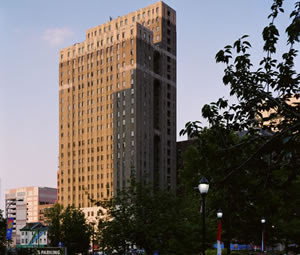 The abrupt downturn in commercial real estate is punishing cities as varied as Detroit, Dallas, and Hartford, where downtown office vacancy rates top 20%. Unoccupied space is piling up quickly in San Antonio, Las Vegas, Charlotte, and San Jose. Outside the U.S., high-profile towers have been halted everywhere from Dubai to Santiago, Chile.
New York, though, may be the epicenter of the bust. The world's biggest office market, with roughly 350 million square feet of floor space, New York added 2.9 million square feet of vacant property in 2009's first quarter alone -- more than the entire Empire State Building. In that same period, calculates commercial real estate brokerage CB Richard Ellis (NYSE:CBG - News), rents slid 14.6% to an average of $57.35 per square foot, the largest quarterly drop on record.
At 8.5%, New York's office vacancy rate is still well under the U.S. average of 14.7%. But with virtually no demand for new space, that percentage is likely to hit double digits within months, putting New York's recovery well behind that of cities such as London, where some analysts and investors think the worst may be over.
Tenants Wanted
Steven J. Pozycki could add to the glut in New York next year. Pozycki, founder of SJP Properties in Parsippany, N.J., is plugging away at a 40-story tower in Midtown Manhattan with 1.1 million square feet of space. The $1 billion project, a joint venture with Prudential Real Estate Investors, was started in early 2007, when property values were still soaring and vacancy rates were at all-time lows. It is scheduled to open next spring but has yet to find a single tenant.
The developer had intended to anchor his building, known as 11 Times Square, with financial companies and law firms. After these would-be renters began teetering, several other developers canceled projects at earlier stages. Boston Properties (NYSE:BXP - News) called off plans for a nearby tower in March. A few weeks later, developer Larry Silverstein said he may delay construction at the World Trade Center site for decades. But Pozycki says that by last fall construction on his site had gone "past the point of no return."
The slide in the office sector mirrors trouble throughout the nonresidential real estate industry. On Apr. 16, General Growth Properties (GGP.), the nation's second-largest mall operator, with 200 shopping centers, filed for bankruptcy. MGM Mirage (NYSE:MGM - News), which is erecting an $8.6 billion complex of stores, offices, hotels, and a casino on the Las Vegas Strip, came close to default this spring. In New Orleans, a $400 million Trump International Hotel & Tower is now on hold until the credit market rebounds.
With homebuilding moribund -- the sector is at its weakest in 50 years -- it's no surprise the U.S. has been shedding more than 100,000 construction jobs a month since December. Meanwhile, new assignments for architecture firms have become all but nonexistent, forcing big names such as New York's Daniel Libeskind to trade down to designing doorknobs and light fixtures.
Putting Work on Hold
Office construction is skidding outside the U.S., as well. Work was halted in March on a Cesar Pelli-designed skyscraper in Santiago, Chile. Building has reportedly stopped on Norman Foster's Russia Tower in Moscow. And many Persian Gulf projects that were green-lighted when oil topped $100 a barrel have been shelved, including the kilometer-high Nakheel Tower in Dubai. "We've had several projects in Dubai that have basically been put on hold until further notice," says Daniel Kaplan, a senior partner at architecture firm FXFowle.
The financial impact will spread. The commercial real estate debt market in the U.S., valued at $3.4 trillion, is three times larger than it was in the early 1990s, creating the potential for huge losses as defaults and bankruptcies rise. Already, delinquencies on commercial mortgage-backed securities have jumped from $3.48 billion in February 2008 to $11.99 billion a year later, and a report from Deutsche Bank (NYSE:DB - News) forecasts they will swell to at least $24 billion before 2010. "It's like subprime," says Richard Parkus, head of CMBS research at Deutsche Bank. "Knowing what's in the delinquency pipeline, we can predict a dramatic rise in defaults."
The expected upsurge is due, in part, to timing. A huge share of commercial mortgages was taken out in the mid-2000s, when building prices were rising to record highs and the loan-to-value ratio was around 90%. Many must be refinanced this year. These days the maximum loan-to-value ratio has fallen to 65%, while property values are plunging. On Mar. 31, for example, the John Hancock Tower in Boston was auctioned off for $660 million -- half the amount a private equity firm shelled out for the property three years ago.
London, Harbinger of Hope
Of course, real estate is a cyclical business. Many of today's troubled office markets were hurt badly in the U.S. recessions in 1990 and 2001. But within a few years, as a halt in construction constrained supply, and businesses began to require more space, vacancy rates shrank, rents climbed, and developers started breaking ground on new towers and Philadelphia apartments.
Some real estate brokers are looking to London for signs of a turnaround. Prices there may be stabilizing after falling nearly 30% in 2008. As a result, equity buyers are emerging to snap up deals, encouraged by the weaker British pound. Hessam Nadji, director of research at real estate brokers Marcus & Millichap, thinks the U.S. may be less than 18 months from leveling off, too. "If there's moderate economic stabilization," he says, "we could see that translate into new demand for commercial office space in mid- or late 2010."
Should that happen, Pozycki's SJP might be positioned well. None of its properties has a loan coming due in the next year or two. Most of the Midtown office buildings that 11 Times Square is competing with date to the mid-20th century. And no other towers are expected to open nearby before 2014. He also has plenty of space.
Story from Yahoo! News
When the housing market began collapsing across the developed world, commercial real estate remained a bastion for builders. But now the global recession is dragging it down, too. Central business districts that only a year ago were crowded with construction projects are emptying out as office tenants cut staff and operations. Building values are sinking, while delinquencies on securitized loans have tripled in the past six months.
The abrupt downturn in commercial real estate is punishing cities as varied as Detroit, Dallas, and Hartford, where downtown office vacancy rates top 20%. Unoccupied space is piling up quickly in San Antonio, Las Vegas, Charlotte, and San Jose. Outside the U.S., high-profile towers have been halted everywhere from Dubai to Santiago, Chile.New York, though, may be the epicenter of the bust. The world's biggest office market, with roughly 350 million square feet of floor space, New York added 2.9 million square feet of vacant property in 2009's first quarter alone -- more than the entire Empire State Building. In that same period, calculates commercial real estate brokerage CB Richard Ellis (NYSE:CBG - News), rents slid 14.6% to an average of $57.35 per square foot, the largest quarterly drop on record.
At 8.5%, New York's office vacancy rate is still well under the U.S. average of 14.7%. But with virtually no demand for new space, that percentage is likely to hit double digits within months, putting New York's recovery well behind that of cities such as London, where some analysts and investors think the worst may be over.
Tenants Wanted
Steven J. Pozycki could add to the glut in New York next year. Pozycki, founder of SJP Properties in Parsippany, N.J., is plugging away at a 40-story tower in Midtown Manhattan with 1.1 million square feet of space. The $1 billion project, a joint venture with Prudential Real Estate Investors, was started in early 2007, when property values were still soaring and vacancy rates were at all-time lows. It is scheduled to open next spring but has yet to find a single tenant.
The developer had intended to anchor his building, known as 11 Times Square, with financial companies and law firms. After these would-be renters began teetering, several other developers canceled projects at earlier stages. Boston Properties (NYSE:BXP - News) called off plans for a nearby tower in March. A few weeks later, developer Larry Silverstein said he may delay construction at the World Trade Center site for decades. But Pozycki says that by last fall construction on his site had gone "past the point of no return."
The slide in the office sector mirrors trouble throughout the nonresidential real estate industry. On Apr. 16, General Growth Properties (GGP.), the nation's second-largest mall operator, with 200 shopping centers, filed for bankruptcy. MGM Mirage (NYSE:MGM - News), which is erecting an $8.6 billion complex of stores, offices, hotels, and a casino on the Las Vegas Strip, came close to default this spring. In New Orleans, a $400 million Trump International Hotel & Tower is now on hold until the credit market rebounds.
With homebuilding moribund -- the sector is at its weakest in 50 years -- it's no surprise the U.S. has been shedding more than 100,000 construction jobs a month since December. Meanwhile, new assignments for architecture firms have become all but nonexistent, forcing big names such as New York's Daniel Libeskind to trade down to designing doorknobs and light fixtures.
Putting Work on Hold
Office construction is skidding outside the U.S., as well. Work was halted in March on a Cesar Pelli-designed skyscraper in Santiago, Chile. Building has reportedly stopped on Norman Foster's Russia Tower in Moscow. And many Persian Gulf projects that were green-lighted when oil topped $100 a barrel have been shelved, including the kilometer-high Nakheel Tower in Dubai. "We've had several projects in Dubai that have basically been put on hold until further notice," says Daniel Kaplan, a senior partner at architecture firm FXFowle.
The financial impact will spread. The commercial real estate debt market in the U.S., valued at $3.4 trillion, is three times larger than it was in the early 1990s, creating the potential for huge losses as defaults and bankruptcies rise. Already, delinquencies on commercial mortgage-backed securities have jumped from $3.48 billion in February 2008 to $11.99 billion a year later, and a report from Deutsche Bank (NYSE:DB - News) forecasts they will swell to at least $24 billion before 2010. "It's like subprime," says Richard Parkus, head of CMBS research at Deutsche Bank. "Knowing what's in the delinquency pipeline, we can predict a dramatic rise in defaults."
The expected upsurge is due, in part, to timing. A huge share of commercial mortgages was taken out in the mid-2000s, when building prices were rising to record highs and the loan-to-value ratio was around 90%. Many must be refinanced this year. These days the maximum loan-to-value ratio has fallen to 65%, while property values are plunging. On Mar. 31, for example, the John Hancock Tower in Boston was auctioned off for $660 million -- half the amount a private equity firm shelled out for the property three years ago.
London, Harbinger of Hope
Of course, real estate is a cyclical business. Many of today's troubled office markets were hurt badly in the U.S. recessions in 1990 and 2001. But within a few years, as a halt in construction constrained supply, and businesses began to require more space, vacancy rates shrank, rents climbed, and developers started breaking ground on new towers and Philadelphia apartments.
Some real estate brokers are looking to London for signs of a turnaround. Prices there may be stabilizing after falling nearly 30% in 2008. As a result, equity buyers are emerging to snap up deals, encouraged by the weaker British pound. Hessam Nadji, director of research at real estate brokers Marcus & Millichap, thinks the U.S. may be less than 18 months from leveling off, too. "If there's moderate economic stabilization," he says, "we could see that translate into new demand for commercial office space in mid- or late 2010."
Should that happen, Pozycki's SJP might be positioned well. None of its properties has a loan coming due in the next year or two. Most of the Midtown office buildings that 11 Times Square is competing with date to the mid-20th century. And no other towers are expected to open nearby before 2014. He also has plenty of space.
Subscribe to:
Posts (Atom)